


96137 CPT Code vs 96136: Key Differences Every Provider Should Know
A denied claim for psychological testing rarely comes down to a coding mistake in the way most people picture it. It comes down to a misunderstanding about what CPT 96136 and CPT 96137 actually measure. Many billers assume 96136 covers psychological testing while 96137 covers neuropsychological testing, or that the two codes describe different kinds of tests altogether. Neither is true. The 96137 CPT code and 96136 are time-based partners: one covers the first block of testing, the other covers every block after it, regardless of whether the tests being administered are psychological, neuropsychological, or a mix of both.
That distinction matters for anyone submitting claims, and it matters even more for students learning the CPT testing code family for the first time. What follows is a breakdown of what each code covers, how they interact with the rest of the psychological and neuropsychological testing codes, and where providers most often lose reimbursement.
What CPT code 96136 covers
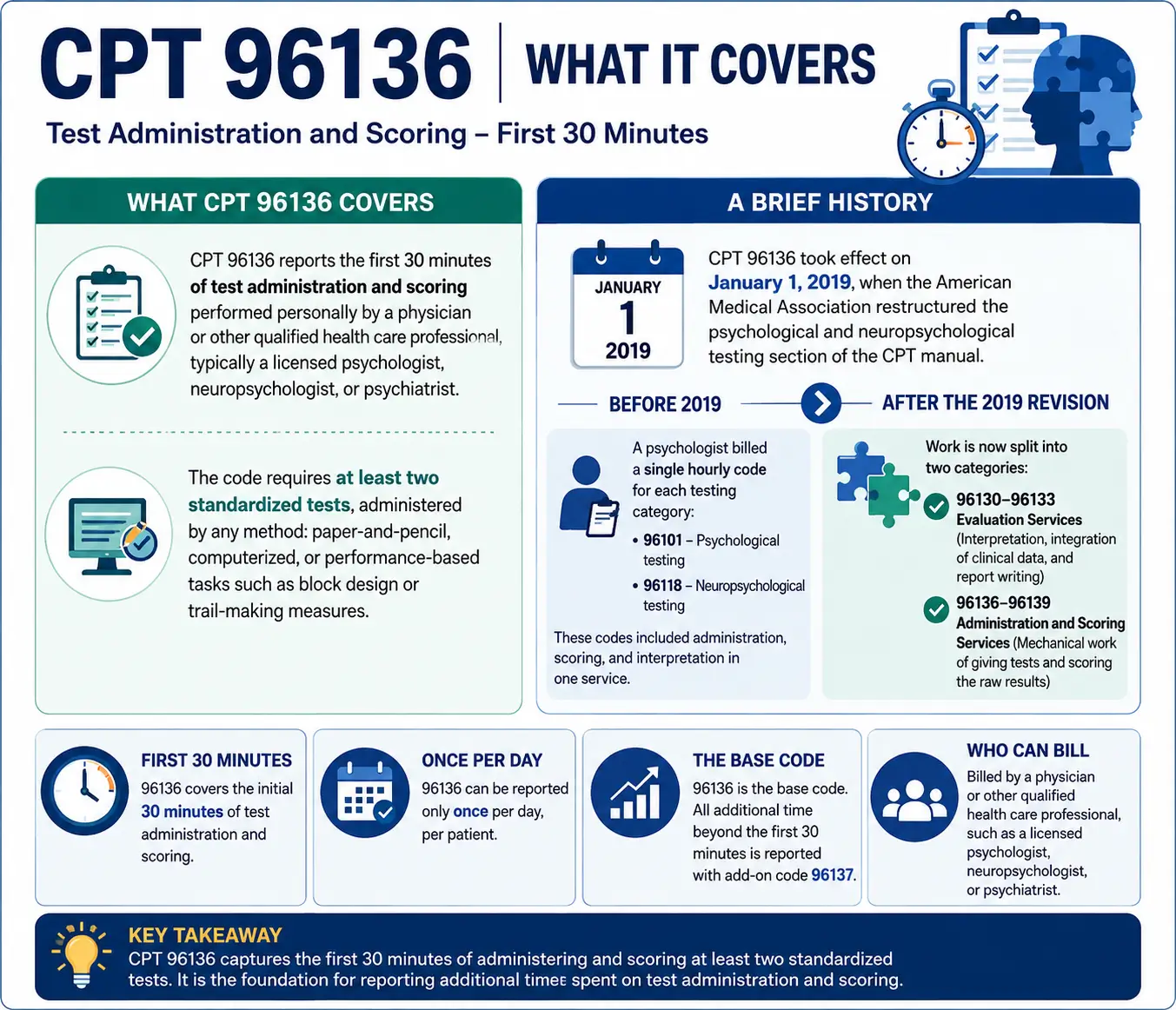
CPT 96136 reports the first 30 minutes of test administration and scoring performed personally by a physician or other qualified health care professional, typically a licensed psychologist, neuropsychologist, or psychiatrist. The code requires at least two standardized tests, administered by any method: paper-and-pencil, computerized, or performance-based tasks such as block design or trail-making measures.
The code took effect on January 1, 2019, when the American Medical Association restructured the psychological and neuropsychological testing section of the CPT manual. Before that date, a psychologist billed a single hourly code for each testing category (96101 for psychological testing, 96118 for neuropsychological testing) that folded administration, scoring, and interpretation into one line. The 2019 revision split that work into two categories: evaluation services (96130-96133), which cover interpretation, integration of clinical data, and report writing, and administration and scoring services (96136-96139), which cover the mechanical work of giving the tests and scoring the raw results.
96136 can be reported only once per day, per patient. It is the base code. Everything beyond the initial half hour moves to its add-on partner.
What CPT code 96137 covers
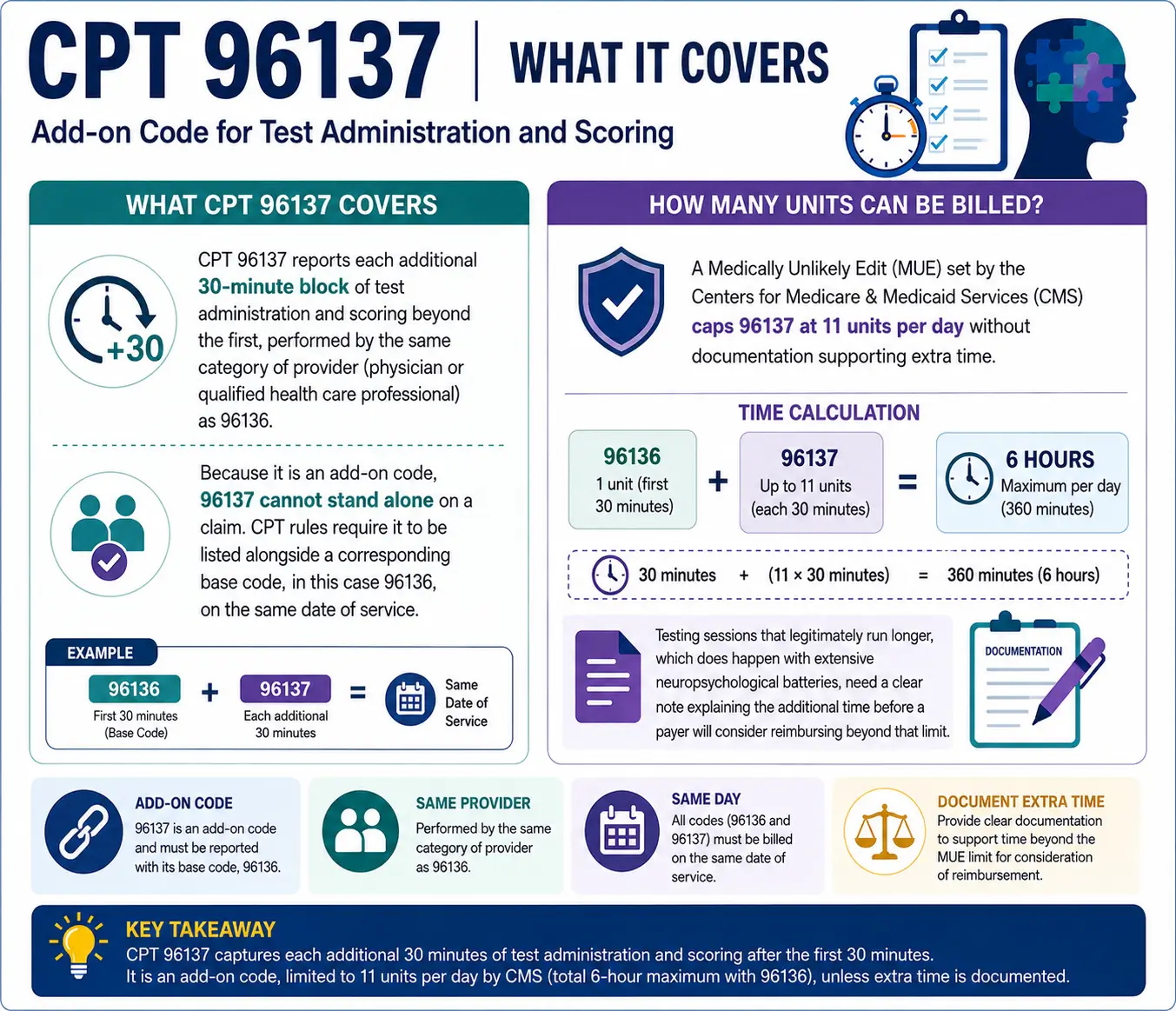
CPT 96137 is an add-on code. It reports each additional 30-minute block of test administration and scoring beyond the first, performed by the same category of provider (physician or qualified health care professional) as 96136. Because it is an add-on code, 96137 cannot stand alone on a claim. CPT rules require it to be listed alongside a corresponding base code, in this case 96136, on the same date of service.
A Medically Unlikely Edit set by the Centers for Medicare & Medicaid Services caps 96137 at 11 units per day without documentation supporting extra time. Combined with the single allowed unit of 96136, that works out to a six-hour ceiling: 30 minutes plus 11 times 30 minutes equals 360 minutes. Testing sessions that legitimately run longer, which does happen with extensive neuropsychological batteries, need a clear note explaining the additional time before a payer will consider reimbursing beyond that limit.
CPT code 96136 vs 96137: differences at a glance
CPT 96136 | CPT 96137 | |
Code type | Base code | Add-on code |
Time captured | First 30 minutes | Each additional 30 minutes |
Performed by | Physician or qualified health care professional | Same provider category as 96136 |
Tests required | Two or more standardized tests | Continuation of the same testing session |
Can be billed alone | Yes | No, must accompany 96136 |
Typical daily limit | 1 unit | Up to 11 units, absent added documentation |
Applies to | Psychological or neuropsychological testing | Psychological or neuropsychological testing |
The row that trips up the most billers is the last one. Both codes apply equally to psychological and neuropsychological testing. There is no separate CPT code for “neuropsychological test administration” the way there is for evaluation services, where 96132/96133 are used for neuropsychological evaluation and 96130/96131 for psychological evaluation. Whether a provider spends the morning administering an intelligence scale and a personality inventory, or a full neuropsychological battery with memory and executive-function measures, the administration and scoring time is captured with the same two codes: 96136 for the first half hour, 96137 for every half hour after that.
How 96136 and 96137 fit into the larger testing code family
96136 and 96137 are two pieces of a five-part structure the AMA created in 2019. Understanding the other three pieces makes it easier to bill the whole encounter correctly.
- 96130/96131: psychological testing evaluation services, first hour and each additional hour. This covers what happens after the tests are scored: interpreting results against clinical data, forming a diagnostic impression, writing the report, and delivering feedback to the patient or family.
- 96132/96133: the neuropsychological equivalent, used when the evaluation addresses cognitive functioning tied to a medical or neurological condition.
- 96136/96137: administration and scoring by a physician or qualified health care professional, the subject of this article.
- 96138/96139: administration and scoring performed by a technician instead of the physician or qualified health care professional, under supervision.
- 96146: a single automated, standardized instrument delivered through an electronic platform, generating a result without requiring dedicated administration time from a professional or technician.
According to APA Services, the practice directorate of the American Psychological Association, evaluation codes and administration codes are meant to be billed together, since evaluation services include selecting which tests to administer in the first place. A claim built only from 96130/96131 without any accompanying 96136-96139 units is likely to raise questions from a payer about what testing actually took place.
The 16-minute rule for counting time
CPT’s general time-reporting convention applies to 96136 and 96137: a provider must be at least 16 minutes into a 30-minute block, one minute past the midpoint, before billing a unit for that block. Fall short, and the extra minutes simply do not count toward a billable unit.
Consider a neuropsychologist who spends 82 minutes personally administering and scoring a battery of tests. The first 30 minutes bill as one unit of 96136. Minutes 31 through 60 bill as one unit of 96137. That leaves 22 minutes remaining in the third block, which clears the 16-minute threshold for a second unit of 96137. Total billed: 96136 x1, 96137 x2. Had the session run 75 minutes instead, only one unit of 96137 would apply, because the remaining 15 minutes in the third block fall one minute short of the threshold for a second add-on unit.
Sessions often stretch across more than one calendar day. APA Services guidance notes that when testing spans multiple dates of service, providers should hold the claim and submit all administration and evaluation codes together once the process is complete, rather than billing piecemeal after each visit.
Documentation that supports the codes
Reviewers looking at 96136 and 96137 claims check for specific elements in the clinical note:
- The name of each standardized test administered during the session
- Start and stop times, or total minutes spent, on administration and scoring
- Identification of who performed the work, the billing physician or qualified health care professional, as distinct from a technician
- A clinical rationale if any test was re-administered, since repeat administration is billable time but needs justification in the chart
Missing time documentation is one of the more common reasons psychological testing claims get flagged on post-payment review. A note that lists which tests were given but never states how long administration took gives a reviewer no way to confirm the number of units billed.
96136 versus 96138: professional time versus technician time
A related point of confusion sits between 96136 (physician or qualified health care professional) and 96138 (technician). Both cover the identical scope of work, administering and scoring two or more standardized tests, but the person performing the work determines which code applies. A trained psychometrist or testing technician working under the general supervision of the psychologist bills 96138 for the first 30 minutes and 96139 for each additional block, following the same 16-minute counting rule as the professional codes.
CMS’s National Correct Coding Initiative includes an edit preventing 96136 and 96138 from being billed for the same patient on the same day without an appropriate modifier, even though it is common practice for a psychologist to administer part of a battery personally while a technician handles another portion. Practices using a mixed model need to apply the correct modifier and keep documentation clear about which provider handled which segment of the session.
Reimbursement also differs between the two codes. Because a physician or qualified health care professional performs the work directly under 96136, Medicare pays it at a higher rate than the technician-administered 96138. In 2026 fee schedule summaries, national non-facility payment amounts run roughly $44 for 96136 versus roughly $38 for 96138, though exact figures shift with each year’s conversion factor and with the Geographic Practice Cost Index for a given locality. CMS finalized two separate conversion factors for 2026: $33.40 for clinicians outside a qualifying Alternative Payment Model, and $33.57 for those inside one, both increases over 2025’s conversion factor of roughly $32.35.
Telehealth and coverage notes
96136 and 96137 have appeared on CMS’s Medicare Telehealth Services List in recent fee schedule cycles, meaning qualifying testing sessions delivered through real-time audio-video connections can be billed with the same codes used for in-person administration, subject to modifier and place-of-service rules that change from year to year. Providers relying on telehealth for testing should confirm current-year placement on the list rather than assuming coverage carries over automatically, since CMS reviews the telehealth list annually as part of its physician fee schedule rulemaking.
Coverage also depends on what is actually being tested. Medicare Administrative Contractors generally do not treat a handful of brief symptom screeners, such as the PHQ-9 or GAD-7 given on their own, as sufficient to justify 96136. Those brief, single-instrument screens are typically billed under 96127 (brief emotional/behavioral assessment, per instrument) or 96146 (automated single-instrument testing), not 96136/96137.
Medical necessity and diagnosis coding
Payers do not reimburse 96136 or 96137 based on time alone. The claim also needs an ICD-10 diagnosis or referral reason that justifies why formal testing, rather than a brief office screen, was clinically indicated. Common reasons include suspected attention-deficit/hyperactivity disorder, autism spectrum evaluations, differential diagnosis of a mood or personality disorder, and workups for memory loss or suspected dementia in older adults. A referral for “cognitive concerns” without a working diagnosis code is a frequent source of pended claims, since the reviewer has no context for why two or more standardized tests were medically necessary rather than optional.
Students learning this code set should note that the diagnosis code belongs to the evaluation, not to the act of administration. The same 96136/96137 units can sit under very different ICD-10 codes depending on the referral question, which is part of why these codes are shared across psychological and neuropsychological testing rather than split by specialty.
Common errors that lead to denials
- Billing 96137 with no accompanying unit of 96136 on the same date
- Billing 96136 for a session built entirely from brief screening tools rather than a battery of standardized tests
- Reporting units without documented start and stop times or total minutes
- Billing 96136 and 96138 for the same patient on the same day without the modifier the NCCI edit requires
- Exceeding the 11-unit cap on 96137 without documentation explaining the extended session
Most of these errors trace back to the same root cause: treating the 96137 CPT code and 96136 as a description of the test rather than a description of the clock. Once that distinction is clear, the rest of the family, evaluation services, technician codes, and the automated single-instrument code, falls into place around it.