



96137 CPT Code Description: Complete Billing & Documentation Guide
Few code families cause as many rejected claims in behavioral health as the psychological testing series. The 96137 CPT code sits at the center of that confusion. It cannot stand on its own, it is measured in half-hour blocks, and the number of units you may report depends on rules that many billers apply incorrectly. This guide walks through what the code covers, how it is timed, what payers expect in the chart, and where claims tend to fall apart.
Get the time math wrong and you either leave money uncollected or invite a takeback during an audit. Both are avoidable.
What the 96137 CPT code covers
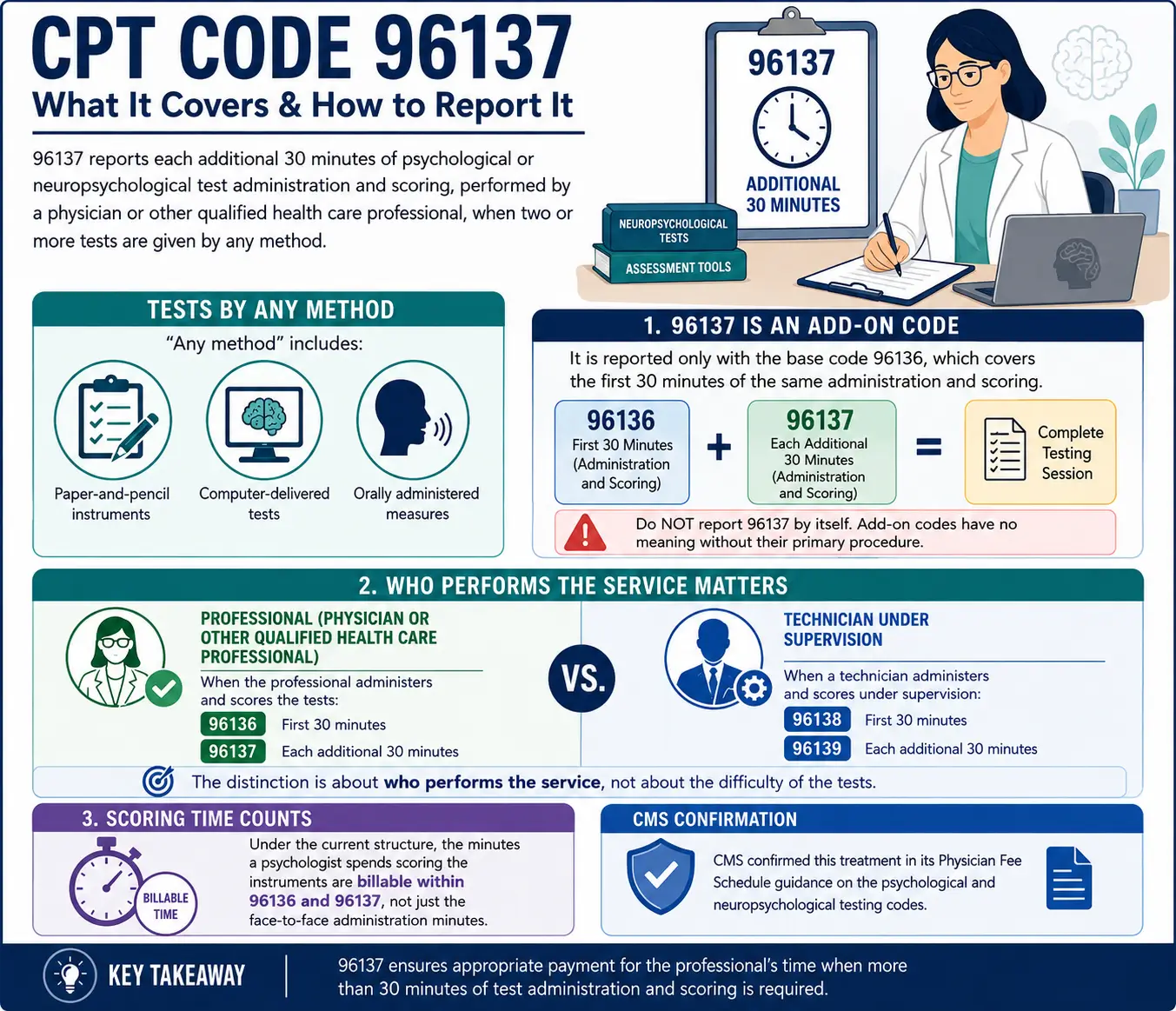
Code 96137 reports each additional 30 minutes of psychological or neuropsychological test administration and scoring, performed by a physician or other qualified health care professional, when two or more tests are given by any method. The phrase “any method” is deliberate. It includes paper-and-pencil instruments, computer-delivered tests, and orally administered measures.
Two details separate this code from its neighbors.
First, 96137 is an add-on code. It is reported only alongside the base code 96136, which captures the first 30 minutes of that same administration and scoring work. Submit 96137 by itself and the line will be denied, because add-on codes have no meaning without their primary procedure.
Second, the professional has to be the one doing the testing. When a technician administers and scores under supervision, the correct codes are 96138 and 96139 instead. The distinction is about who performs the service, not about the difficulty of the tests.
One point that changed clinician workflow after 2019 is worth stating plainly. Scoring time counts. Under the current structure, the minutes a psychologist spends scoring the instruments are billable within 96136 and 96137, not just the face-to-face administration minutes. CMS confirmed this treatment in its Physician Fee Schedule guidance on the psychological and neuropsychological testing codes.
How 96137 fits into the 2019 testing code overhaul
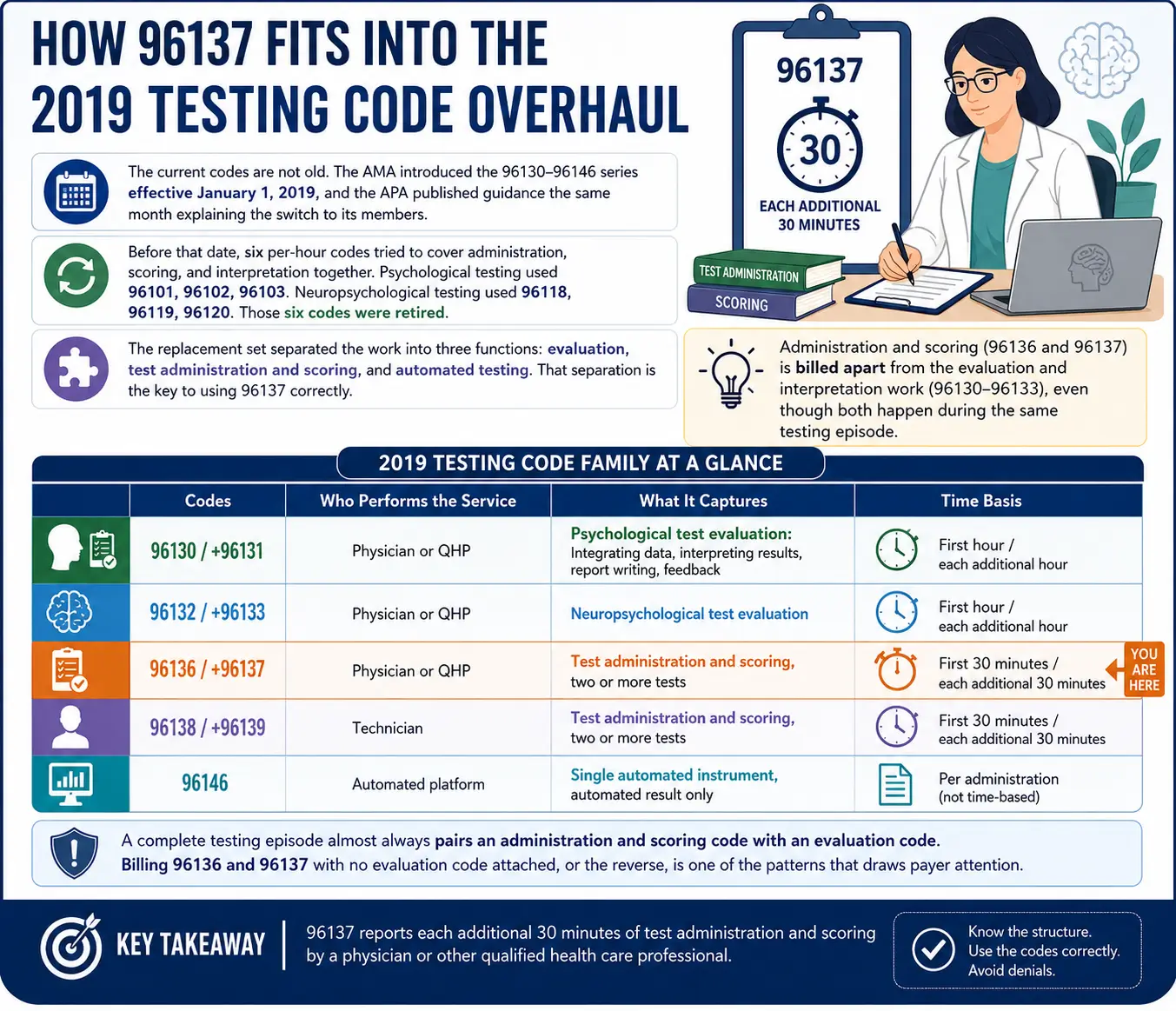
The current codes are not old. The American Medical Association introduced the 96130 through 96146 series effective January 1, 2019, and the American Psychological Association published guidance the same month explaining the switch to its members.
Before that date, a handful of per-hour codes tried to cover administration, scoring, and interpretation together. Psychological testing ran through 96101, 96102, and 96103. Neuropsychological testing ran through 96118, 96119, and 96120. Those six codes were retired. The replacement set pulled the work apart into three functions: evaluation, test administration and scoring, and automated testing.
That separation is the key to using 96137 correctly. Administration and scoring (96136 and 96137) is billed apart from the evaluation and interpretation work (96130 through 96133), even though both happen during the same testing episode.
Here is how the full family lines up.
|
Codes |
Who performs the service |
What it captures |
Time basis |
|
96130 / +96131 |
Physician or QHP |
Psychological test evaluation: integrating data, interpreting results, report writing, feedback |
First hour / each additional hour |
|
96132 / +96133 |
Physician or QHP |
Neuropsychological test evaluation |
First hour / each additional hour |
|
96136 / +96137 |
Physician or QHP |
Test administration and scoring, two or more tests |
First 30 minutes / each additional 30 minutes |
|
96138 / +96139 |
Technician |
Test administration and scoring, two or more tests |
First 30 minutes / each additional 30 minutes |
|
96146 |
Automated platform |
Single automated instrument, automated result only |
Per administration (not time-based) |
Reading the table, a common question answers itself. A complete testing episode almost always pairs an administration and scoring code with an evaluation code. Billing 96136 and 96137 with no evaluation code attached, or the reverse, is one of the patterns that draws payer attention.
Time rules that decide how many 96137 units you can bill
This is where most 96137 errors live. The codes follow the standard CPT time convention. To report one unit of a 30-minute code, you must provide at least 16 minutes of that increment. In other words, you have to pass the midpoint of the block before it counts. The American Psychological Association’s coding resources and multiple payer policies state the threshold the same way.
Apply that rule to a real session and the unit counts become predictable.
|
Total administration and scoring time |
Codes to report |
|
Up to 45 minutes |
96136 x 1 |
|
46 to 75 minutes |
96136 x 1 and 96137 x 1 |
|
76 to 105 minutes |
96136 x 1 and 96137 x 2 |
|
106 to 135 minutes |
96136 x 1 and 96137 x 3 |
The pattern continues from there. Every full 30-minute block adds one unit of 96137, and a partial block only earns a unit once you reach 16 minutes into it.
A worked example makes the cutoff concrete. Say a psychologist administers and scores three standardized instruments and the combined administration and scoring time totals 100 minutes. The first 30 minutes are 96136. The next 60 minutes are two units of 96137. The final 10 minutes are not billable, because 10 minutes falls short of the 16-minute threshold for a fourth block. The claim reads 96136 x 1 and 96137 x 2.
Now change the total to 108 minutes. The last block has reached 18 minutes, past the midpoint, so it earns a unit. The claim becomes 96136 x 1 and 96137 x 3.
Keep a running time log during testing. Reconstructing minutes after the fact is exactly what auditors probe.
Unit limits and the medically unlikely edit
Time is not the only ceiling. CMS also caps how many units of 96137 it expects on a single day through its National Correct Coding Initiative.
96137 carries a Medically Unlikely Edit of 11 units. Combined with the base code, that allows a maximum of 6 hours of professional administration and scoring for one patient on one date of service under ordinary circumstances. Report more than 11 units of 96137 and the excess is likely to be denied.
The edit is not always an absolute wall. MUEs are assigned an adjudication indicator that governs how they behave. Date-of-service edits based on clinical benchmarks (indicator 3) can be paid above the limit if you appeal with documentation showing the additional units were medically necessary and correctly reported. Edits based on policy are stricter. Either way, the safest path is to document the clinical need for extended testing at the time you provide it, rather than building the justification after a denial arrives.
For context, the technician add-on 96139 shares the same 11-unit cap, while the automated code 96146 is limited to a single unit per day.
Documentation that survives an audit
Coverage for these services is not tied to a fixed diagnosis list. CMS coverage articles for psychological and neuropsychological testing note that there is no set of covered ICD-10 codes, so the burden shifts to the record to show why the testing was reasonable and necessary.
A defensible chart for a 96137 claim generally includes:
- The reason for referral and the diagnosis or suspected diagnosis that prompted testing
- The specific tests administered and scored
- Start and stop times, or total time, for administration and scoring
- Who performed each part of the service, by name and credential
- Interpretation of results and any treatment recommendations
Time entries deserve special attention. Because 96137 is billed in defined blocks, “approximately two hours” is not enough. Record the minutes. When testing is split across more than one day, add the time together and report the total on the last date of the episode, using the base code once and 96137 for the additional units. Billing a fresh unit of the base code on each day of a multi-day battery is a frequent and correctable mistake.
Common billing mistakes with 96137
Denials in this family tend to repeat. A few show up again and again.
Reporting 96137 without 96136. The add-on has no standalone value. It always follows the base code.
Billing screening questionnaires as full testing. Administering only brief symptom inventories such as the PHQ-9 or GAD-7 does not qualify as psychological or neuropsychological testing under these codes. As of a July 2020 CMS update, testing made up solely of brief screening instruments should be reported with 96127 or, for a single automated instrument, 96146, not 96136 and 96137.
Meeting the two-test requirement. The descriptor specifies two or more tests. A single non-automated test administered by a professional does not fit 96136 and 96137 as written, which is a limitation worth checking before you code.
Mixing professional and technician time carelessly. If both a psychologist and a technician administer tests to the same patient on the same day, the professional codes (96136 and 96137) and technician codes (96138 and 96139) are reported for their respective portions, and a modifier such as 59 or XE may be required to show they are separate services. Do not double-count the same minutes across both.
Telehealth assumptions. These services can be delivered remotely in many cases, with modifier 95 appended to show the telehealth setting. Medicare telehealth flexibilities have carried shifting expiration dates, though, so confirm current policy and payer rules before you rely on remote billing.
Reimbursement basics for 96137
There is no single national dollar figure for 96137, and any source that quotes one flat rate is oversimplifying.
Medicare payment comes from the Physician Fee Schedule. Each code carries three relative value units, for physician work, practice expense, and malpractice. Those RVUs are adjusted by geographic indices for your locality and then multiplied by an annual conversion factor. CMS set that conversion factor at $32.3465 for 2025 and $33.4009 for 2026. Because 96137 is time-based and the geographic adjustment changes the result from region to region, the paid amount per unit differs across the country. Commercial and Medicaid payers set their own schedules on top of that.
Two practical notes follow from the math. Units multiply the payment, so accurate time capture has a direct effect on the check. And because 96137 is an add-on, its value is paid on top of the base code rather than being folded into it, which is one reason correct base-plus-add-on reporting matters for the bottom line.
To price a specific claim, look up the current RVUs for 96137 in the Physician Fee Schedule for your Medicare locality, or check your contracted rate with a commercial payer, rather than relying on a rule-of-thumb amount.