



99493 CPT Code Description: Complete Guide for Behavioral Health Billing
CPT 99493 reports psychiatric collaborative care management during subsequent months of treatment. The 99493 CPT code description centers on behavioral health care manager activities performed with psychiatric consultation and direction from the treating physician or another qualified healthcare professional.
The code describes the first 60 minutes of this monthly work. However, selecting it requires more than adding up telephone calls. The practice must deliver the collaborative care model, including structured follow-up, measurement of symptoms, and psychiatric input. The American Academy of Family Physicians explains these distinctions in its undated Behavioral Health Integration Coding resource.
For providers and billing students, the practical questions are straightforward: Does the service meet the model’s requirements? Which activities count? Does the documentation support the monthly claim?
What the 99493 CPT code description includes
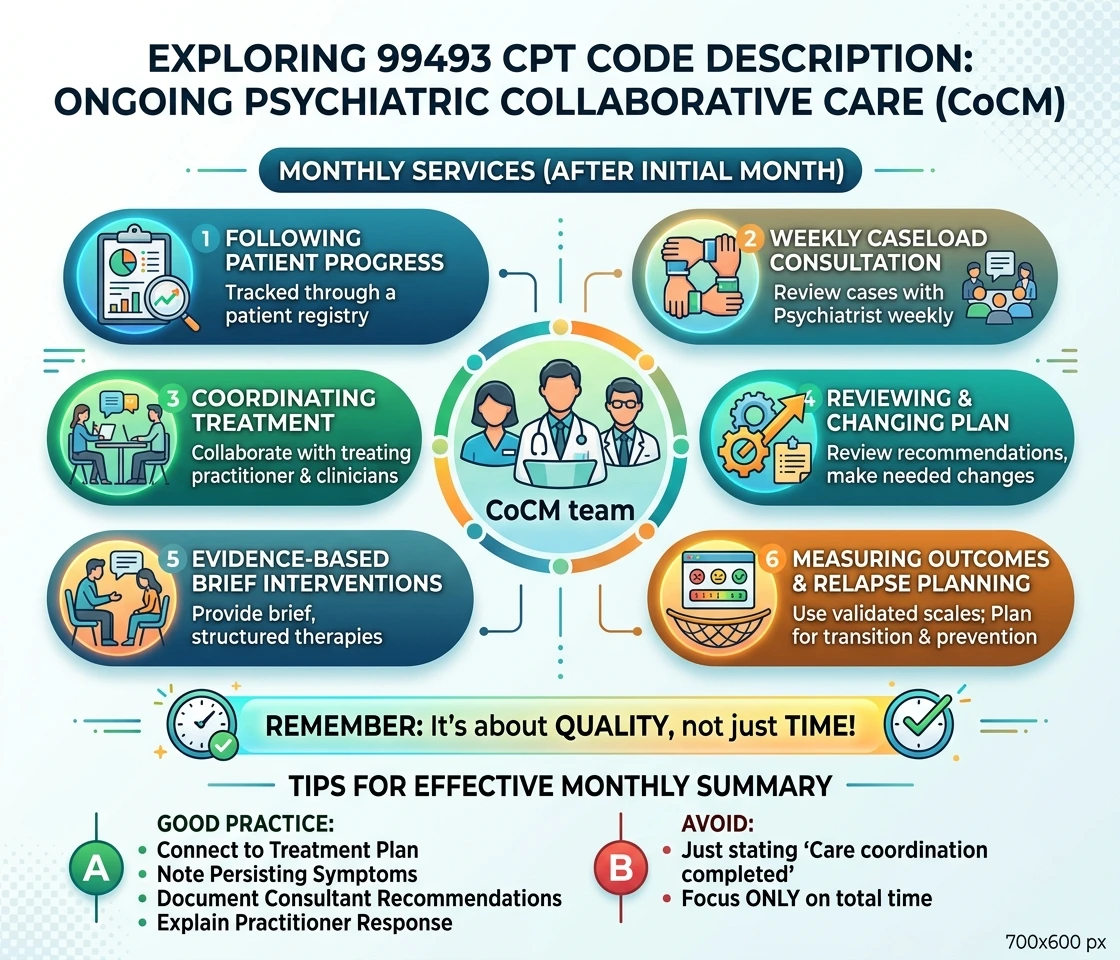
In plain language, 99493 covers ongoing psychiatric collaborative care management, commonly abbreviated CoCM, after the initial treatment month.
The American Psychiatric Association’s CoCM and General BHI FAQs, updated June 2019, describes ongoing services that include:
- Following the patient’s progress through a registry.
- Participating in weekly psychiatric caseload consultation.
- Coordinating treatment with the treating practitioner and other clinicians.
- Reviewing treatment recommendations and making indicated changes.
- Providing brief interventions using evidence-based methods.
- Measuring outcomes with validated rating scales.
- Preparing relapse prevention plans as patients approach treatment goals.
These activities explain why a monthly time total alone cannot establish eligibility for 99493. A note stating only “care coordination completed” does not clearly describe the service provided.
An effective monthly summary connects the work performed to the patient’s treatment plan. For example, it might explain which symptoms persisted, what the psychiatric consultant recommended, and how the treating practitioner responded.
How 99493 differs from related behavioral health codes
The following comparison summarizes the service distinctions described by the American Academy of Family Physicians. The listed times are descriptor values and should be interpreted in conjunction with the applicable reporting thresholds.
Code | Service | Time described |
99492 | Initial month of psychiatric collaborative care | First 70 minutes |
99493 | Subsequent month of psychiatric collaborative care | First 60 minutes |
99494 | Additional CoCM time, reported with an eligible base code | Each additional 30 minutes |
G2214 | Shorter initial or subsequent month of CoCM | First 30 minutes |
99484 | General behavioral health integration | At least 20 minutes |
General behavioral health integration and CoCM have different staffing and service requirements. Code selection should reflect the program actually delivered, rather than whichever code matches the recorded minutes.
Who participates, and who submits the claim?
The Centers for Medicare & Medicaid Services’ January 2026 booklet on Behavioral Health Integration Services outlines three professional roles:
Treating practitioner: Directs care and bills the service. Eligible Medicare practitioners include physicians and specified nonphysician practitioners whose scope includes evaluation and management services.
Behavioral health care manager: Has formal education or specialized behavioral health training and works under the treating practitioner’s oversight.
Psychiatric consultant: Has psychiatric training and qualifications to prescribe the full range of medications.
Medicare permits general supervision for services the billing practitioner does not personally perform. Physical presence during each activity is unnecessary, but responsibility for direction and control remains.
Before opening a CoCM billing program, assign these roles explicitly. A useful operational record identifies the supervising practitioner, care manager, consultant, and arrangement for communicating recommendations. This helps billing staff distinguish active clinical participation from a name listed on an enrollment form.
How many minutes are required for 99493?
The descriptor states 60 minutes, but the CPT reporting threshold begins at 31 minutes when the applicable midpoint rule applies.
The American Psychiatric Association’s June 2019 guidance provides these subsequent-month ranges:
Qualifying monthly time | Reporting |
31–75 minutes | 99493 |
76–105 minutes | 99493 plus one unit of 99494 |
Thus, 65 minutes does not support an additional unit simply because the total exceeds 60. The first add-on threshold is 76 minutes.
North Carolina Medicaid’s December 30, 2025, Updated Coverage for Psychiatric Collaborative Care Management also specifies a 31-minute minimum for 99493 and at least 16 additional minutes for 99494. Its policy recognizes G2214 beginning at 16 minutes and prohibits combining G2214 with 99492, 99493, or 99494 in the same calendar month. These are useful payer-specific instructions, but other plans’ policies still require review.
Use actual documented time. A template that automatically assigns identical minutes to every contact makes the claim harder to reconcile with the clinical record.
Which activities count toward monthly time?
The University of Washington AIMS Center’s Quick Guide on Behavioral Health Integration Services, updated January 27, 2026, identifies qualifying care manager work such as patient engagement, registry tracking, symptom assessment, brief interventions, psychiatric caseload review, and relapse prevention planning.
The guide distinguishes care manager minutes from the psychiatric consultant’s and treating practitioner’s work included in the service’s valuation. Do not automatically combine all three professionals’ time into one total.
North Carolina Medicaid additionally allows treating practitioners’ time when they personally perform qualifying care manager activities, provided those activities are not counted toward another reported service. This illustrates why timekeeping policies should identify both the worker and the activity performed.
A practical log should record the date, person performing the work, clinical activity, minutes, and connection to the treatment plan. Keep billing administration separate from clinical service documentation.
Consent and the initiating visit
Medicare requires advance patient permission for relevant specialist consultation. Patients must also receive information about applicable cost sharing. Verbal consent is acceptable when documented, and new consent is required when the patient changes billing practitioners, according to CMS’s January 2026 booklet.
The AIMS Center’s January 2026 guide explains that an initiating visit is required for new patients and patients not seen within the year before starting integrated behavioral health services. The visit establishes the treating relationship and allows assessment before enrollment.
For billing operations, place consent and initiating-visit information somewhere reviewers can locate without searching through months of notes. A documented date and a link to the relevant encounter are more useful than an unchecked enrollment field.
Documentation that supports the monthly claim
Build the documentation around the care delivered. A useful internal review checklist asks:
- Is the reason for ongoing behavioral health management clear?
- Can the reviewer locate the current treatment plan?
- Do follow-up notes show symptom monitoring and patient response?
- Are psychiatric recommendations and resulting decisions traceable?
- Can the monthly minutes be reconciled to individual entries?
- Has the reviewer checked for time already assigned to another service?
These questions translate the service requirements into a review process. They should supplement the clinical record rather than replace it with a billing checklist.
For example, “symptoms unchanged” provides limited context. A stronger entry identifies the assessment used, the patient’s reported difficulties, and the decision to continue or modify treatment. Do not document an intervention solely because the template contains a designated field for it.
Can 99493 be billed with psychotherapy or chronic care management?
CMS’s Frequently Asked Questions about Billing Medicare for Behavioral Health Integration Services, dated December 5, 2023, permits separately reportable psychotherapy and other psychiatric services during the same month when the professional meets the relevant requirements.
Time and effort cannot be counted twice.
The same FAQ allows behavioral health integration and chronic care management during one month when both services are reasonable and necessary, separate requirements and consent are satisfied, and work is not duplicated.
CMS also states that a single practitioner must choose between general BHI and CoCM for the same beneficiary during a given month. Reporting 99484 alongside 99493 is therefore not a way to recover additional coordination time.
A practical subsequent-month billing example
Consider this hypothetical internal review:
A patient already enrolled in CoCM receives 20 minutes of follow-up assessment, 15 minutes of a brief behavioral intervention, 10 minutes of patient-specific caseload review, and 15 minutes of qualifying coordination and registry work.
The documented total is 60 minutes.
Assuming all service requirements and payer conditions are satisfied, the subsequent-month code is 99493. If qualifying work instead totals 80 minutes, the APA’s published reporting range supports 99493 plus one unit of 99494.
The reviewer should still inspect what those entries contain. Four time entries labeled “follow-up” provide less useful evidence than four entries showing the clinical purpose and result.
Reimbursement and 2026 coding considerations
There is no single payment figure that every practice should expect to collect.
The AIMS Center’s January 2026 Medicare payment summary lists 99493 at $144.96 for nonfacility services and $89.51 for facility services. These published reference amounts should not substitute for checking the applicable payer allowance.
For revenue estimates, record the fee-schedule year, setting, payer, and applicable payment methodology alongside the amount. Separate the allowed charge from the amount ultimately collected.
CMS’s January 2026 booklet also identifies optional, non-time-based behavioral health add-on codes for patients receiving advanced primary care management in the same month. Practices using APCM should review that pathway before assuming their existing CoCM coding workflow remains appropriate.
Putting the description into practice
The 99493 CPT code description combines subsequent-month collaborative care, qualifying care manager time, and defined clinical activities. A defensible claim connects those elements: the team delivered the required services, the record explains the patient’s progress, and the time log supports the reported code. Review all three before releasing the monthly claim.