



90792 CPT Code Documentation Requirements: A Complete Checklist
Meeting 90792 CPT code documentation requirements means showing why a psychiatric diagnostic evaluation was necessary, what the clinician found, and which medical services were provided. A diagnosis and an imported medication list do not explain the assessment behind a treatment decision.
CPT 90792 describes a psychiatric diagnostic evaluation that includes medical services. First Coast Service Options’ Medicare policy L33252, revised effective July 1, 2020, describes history, mental status examination, physical examination elements when indicated, a diagnostic impression, and assessment of the patient’s ability to participate in treatment.
The checklist below separates the evaluation record from additional clinical recommendations and payer conditions. Apply the coverage policy effective for the patient’s plan and service date.
What distinguishes 90792 from 90791?
Both codes describe psychiatric diagnostic evaluations. 90792 includes medical services; 90791 excludes them. CMS makes this distinction in its Medicare National Correct Coding Initiative (NCCI) Policy Manual, Chapter XI, revised January 1, 2026.
Medical services can include evaluating medication options, examining relevant physical findings, or considering medical conditions that affect psychiatric treatment. The American Psychiatric Association’s Office of Healthcare Systems and Financing explained these examples in its 2014 coding background materials. A new prescription is not required at every evaluation.
Provider eligibility also matters. Verify that the clinician’s license, scope of practice, and payer enrollment permit the medical service being reported. A practice’s psychiatric specialty designation alone does not establish an individual clinician’s eligibility.
90792 CPT code documentation requirements: the checklist
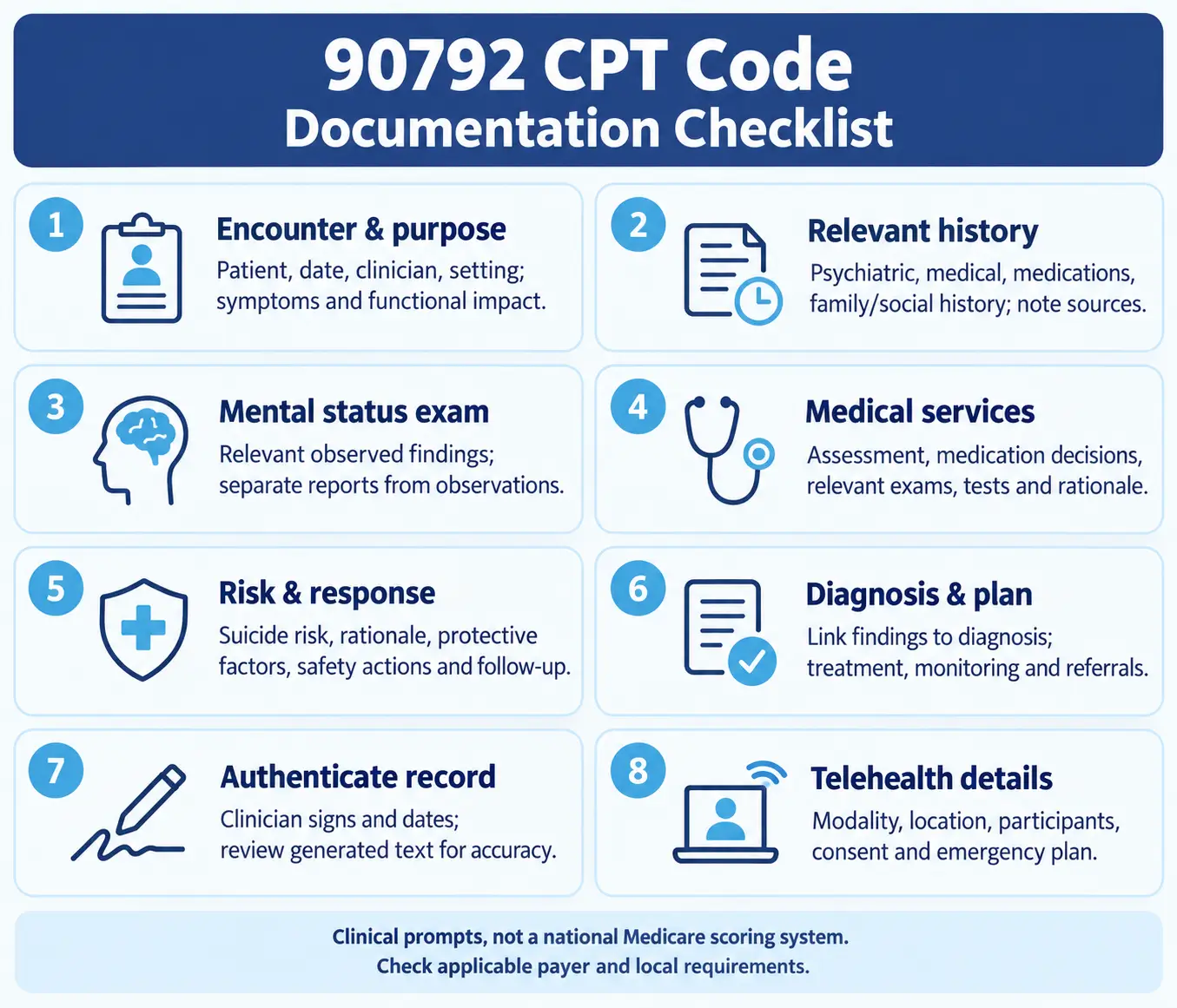
Use these items to review the actual encounter. Clinical prompts such as risk assessment help explain care, but they should not be presented as a single national Medicare scoring system. Local policies can impose additional requirements.
1. Identify the encounter and reason for evaluation
Record the patient’s identifying information, service date, clinician, and encounter setting. Identify the referral source when applicable and explain the question the evaluation is intended to answer.
Describe the presenting symptoms, their course, and their effect on daily functioning. For example, an original hypothetical entry might describe several weeks of worsening concentration that interferes with completing work assignments.
First Coast’s billing article A57520, effective January 1, 2025, requires legible records with patient identification, service dates, clinician authentication, and support for the reported procedure and diagnosis codes.
2. Document the history used in clinical reasoning
The APA’s 2013 CPT Primer for Psychiatrists identifies the presenting concern, history of the current illness, pertinent systems review, family and psychosocial history, and mental status examination as evaluation components.
Useful history prompts include:
- Previous psychiatric diagnoses, treatment, admissions, and responses.
- Relevant medical conditions and physical symptoms.
- Current and previous medication use, effectiveness, and adherence.
- Family history and social circumstances affecting assessment or treatment.
Distinguish patient reports from information obtained through records or collateral contacts. If important information remains unavailable, identify the gap and the plan to obtain it. First Coast’s evaluation policy recognizes information from family members and other clinicians as potential sources.
3. Describe the mental status examination
Document observed findings across relevant domains: appearance, behavior, speech, mood, affect, thought organization and content, orientation, consciousness, insight, and judgment.
These domains appear in Acentra Health’s West Virginia 90792 review tool, finalized April 1, 2026. That tool is a program-specific example of how an evaluation may be reviewed, rather than a national checklist.
Separate what the patient reports from what the clinician observes. A patient’s description of low mood and the clinician’s observation of restricted affect provide different information. Record limitations when a domain could not be assessed; avoid automatically populating normal findings.
4. Make the medical services identifiable
Describe the medical assessment and its effect on decisions. Depending on the encounter, relevant documentation may include:
- Medication options considered and reasons for starting, continuing, changing, or deferring treatment.
- Physical examination findings relevant to the presenting problem.
- Laboratory or diagnostic studies reviewed or ordered, with their purpose.
- Medical conditions that influenced psychiatric treatment choices.
An imported medication list leaves the clinician’s assessment unstated. Explain what was evaluated and decided.
The APA’s 2014 guidance includes considering a prescription and modifying treatment because of medical comorbidities among medical activities. This supports documenting a reasoned decision to defer medication when that reflects the service performed.
Physical examination elements should match clinical indications. First Coast’s policy does not prescribe an identical physical examination for every evaluation.
5. Record risk assessment and the response
Document the assessment of suicide risk, including relevant thoughts, intent, previous behavior, risk factors, and protective factors. Explain the clinical judgment and resulting actions.
The Substance Abuse and Mental Health Services Administration’s SAFE-T: Suicide Assessment Five-Step Evaluation and Triage, published December 2024, recommends documenting risk level, its rationale, interventions, and follow-up.
Where indicated, record safety planning, counseling about access to lethal means, involvement of support people, and arrangements for further assessment. A checked denial of suicidal thoughts cannot communicate the entire risk formulation. The record should make the reasoning and response understandable to the next clinician.
6. Connect findings, diagnosis, and treatment recommendations
Explain how the history and examination support the diagnostic impression. Identify unresolved diagnostic questions and the information needed to answer them. Match claim diagnoses to the documented assessment and applicable coding rules.
Treatment recommendations should identify the proposed interventions, follow-up arrangements, monitoring, and referrals. Record the patient’s preferences and ability to participate.
The APA’s 2015 Practice Guidelines for the Psychiatric Evaluation of Adults, Third Edition, recommends explaining treatment options and their risks and benefits, and documenting the reasons for treatment selection.
A plan to obtain prior records should identify which records are needed and who will review them. A follow-up recommendation should be specific enough for the patient and clinical team to act on.
7. Authenticate the completed record
Ensure the responsible clinician signs and dates the documentation.
CMS’s July 2025 fact sheet, Complying with Medicare Signature Requirements, states that reviewers look for signed and dated records from those responsible for care. It also addresses notes prepared with a scribe or artificial intelligence: the clinician must authenticate the entry.
Review generated text before signing. Correct contradictory findings, inaccurate medication information, and statements describing work that was not performed.
8. Add documentation for remote encounters
For telehealth, record the communication method, patient location, participants, and consent required by the applicable rules. HHS guidance explains that telebehavioral health consent can be documented through written, electronic, or verbal processes, subject to governing requirements.
HHS’s September 18, 2024 guidance on telebehavioral emergencies recommends documenting the patient’s current address, local emergency resources, a nearby support contact, and a plan for connection failure during an emergency.
These details support safe remote care. They do not replace the psychiatric and medical assessment.
Does 90792 require a minimum number of minutes?
90792 is not a timed code. Novitas Solutions’ Medicare LCD L35101, revised effective January 1, 2024, explicitly describes psychiatric diagnostic evaluations as untimed while requiring documentation of session length.
That distinction matters during chart review. An untimed code can still carry a payer requirement to record duration.
Document actual time when required. Do not treat a scheduled appointment length as evidence that the evaluation was completed, or import a psychotherapy time threshold into 90792 coding.
When can a repeat evaluation be supported?
Document the clinical reason for reassessment and check the payer’s frequency policy.
Wisconsin Physicians Service’s article A57480, effective January 1, 2026, recognizes circumstances such as a significant mental status change, psychiatric inpatient admission, or an extended treatment interruption. It describes approximately six months as an extended break under that contractor’s policy.
That interval is not a universal national rule. An annual intake template or a calendar reminder does not establish medical necessity. The note should explain what changed, what requires renewed diagnostic assessment, and why the current encounter supports another evaluation.
Check other services billed on the same date
CMS’s 2026 NCCI manual prohibits reporting an E/M code with 90792. It also states that psychiatric diagnostic evaluations are not separately reportable with psychotherapy codes for the same service date.
Review these restrictions before adding an office visit or psychotherapy charge to the evaluation claim. For encounters involving different clinicians, review the applicable provider, group, and payer rules. A second note does not automatically establish separate payment.
A practical documentation example
Consider a hypothetical patient referred for worsening depressive symptoms. The clinician completes the psychiatric history, mental status examination, risk assessment, diagnostic formulation, and treatment recommendations.
During the medical assessment, the clinician evaluates current medications and possible interactions, then defers a new prescription until specific outside records are reviewed.
The medical-services section should identify the medications considered, the concern requiring clarification, the decision made, and the follow-up responsibility. Merely recording that no medication was prescribed would omit the work behind that decision.
This example illustrates documentation structure, not a complete patient note or a guarantee of coverage.
Review the record before releasing the claim
A record that supports 90792 CPT code documentation requirements connects the reason for evaluation, psychiatric findings, medical services, and treatment decisions. Confirm clinician authentication and apply the payer’s rules for duration, repeat evaluations, and same-day services.
If the medical work cannot be identified, obtain clarification before billing. A completed template should accurately describe the care delivered.