



Medicare Supervisory Billing Rules for Mental Health Providers Explained
A signed progress note does not necessarily establish who may bill Medicare for a therapy appointment. The answer also depends on who initiated treatment, who delivered the service, and whether the billing professional has the appropriate Medicare benefit.
Medicare supervisory billing rules permit general supervision for qualifying behavioral health services billed incident to an eligible practitioner. The supervisor’s presence during the appointment is not required. Other payment conditions still apply.
For providers and billing students, the starting point is the billing arrangement. Establish that before choosing a supervisor’s National Provider Identifier (NPI) for the claim. The discussion below concerns Original Medicare Part B office services.
Separate personal services from incident-to services
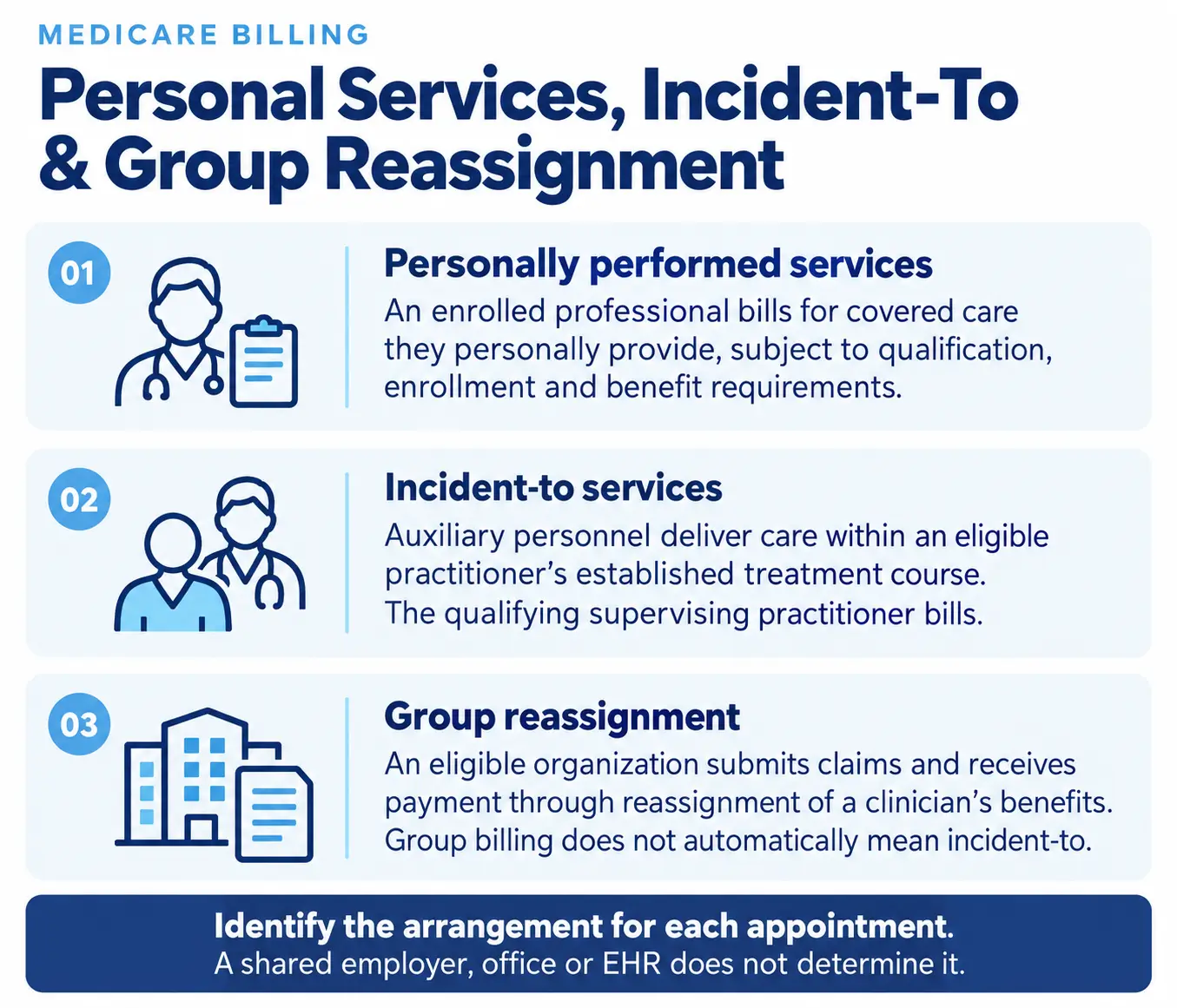
A Medicare-enrolled professional may submit a claim for a covered service they personally perform, provided their qualifications, enrollment, and benefit requirements are satisfied.
Incident-to billing follows another arrangement: auxiliary personnel deliver care that forms part of an eligible practitioner’s established treatment course. The qualifying supervising practitioner bills for that work under the incident-to provision.
A group practice can also receive payment through reassignment of an enrolled clinician’s benefits. As CMS explains in its May 2024 MFT/MHC enrollment FAQs, reassignment authorizes the eligible organization to submit claims and receive payment for that practitioner. Group billing therefore does not automatically mean the service was incident to someone else.
These distinctions should appear in the practice’s billing procedures. A shared employer, office address, or electronic record does not answer which arrangement applies to an individual appointment.
Medicare supervisory billing rules allow general supervision
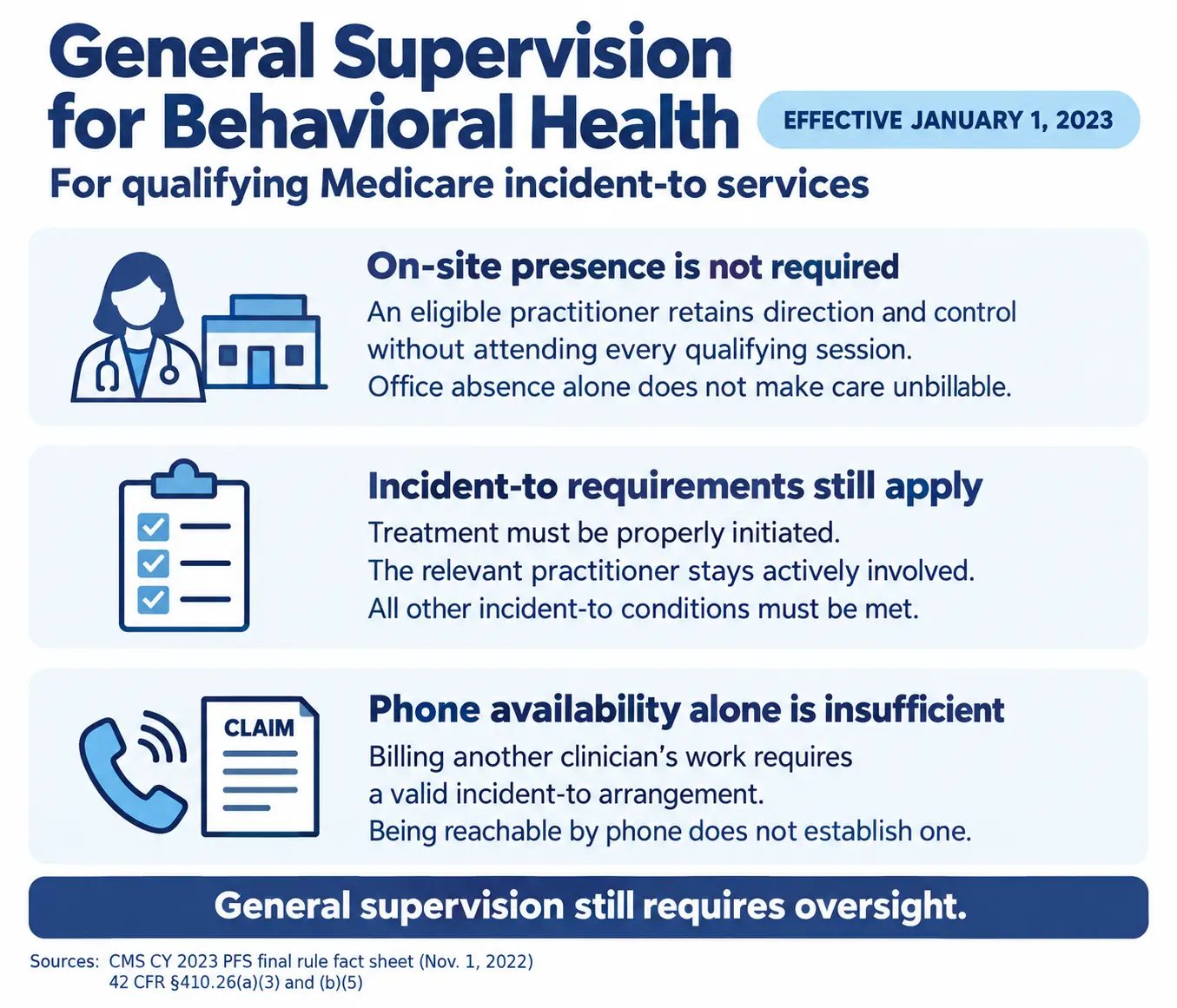
The Centers for Medicare & Medicaid Services (CMS) changed the supervision requirement for qualifying incident-to behavioral health services beginning January 1, 2023. Its November 1, 2022, Physician Fee Schedule final-rule fact sheet describes the exception to the usual direct-supervision standard.
Under general supervision, the eligible practitioner retains responsibility for the direction of care without having to attend each session. Federal regulation 42 CFR §410.26 permits this arrangement for qualifying behavioral health services delivered by auxiliary personnel.
That flexibility affects staffing. A therapist’s otherwise eligible appointment does not become unbillable solely because the supervising psychiatrist is away from the office.
However, telephone availability alone does not establish the whole incident-to relationship. The practice must still show that treatment was properly initiated and that the relevant practitioner remains involved. General supervision does not authorize an unrelated clinician to adopt another professional’s services for billing purposes.
Check the supervisor’s Medicare benefit category
The authority to oversee someone’s clinical development is different from the authority to bill their services. State licensing rules may permit a professional to supervise an associate, while Medicare provides no incident-to benefit under that supervisor’s practitioner category.
CMS’s March 2026 Medicare & Mental Health Coverage booklet identifies the following distinctions.
Practitioner category | Can qualifying auxiliary services be billed incident to this practitioner? |
Physician, including psychiatrist | Yes |
Clinical psychologist | Yes |
Nurse practitioner, physician assistant, clinical nurse specialist, or certified nurse-midwife | Yes, within applicable scope and benefit limits |
Clinical social worker | No |
Marriage and family therapist or mental health counselor | No |
For example, an independently licensed clinical social worker cannot bill an associate’s psychotherapy under the social worker’s Medicare benefit simply because they review the associate’s cases. Conversely, a social worker may perform eligible services as auxiliary personnel within a qualifying physician-supervised arrangement.
Counselors and family therapists have an independent billing option
Medicare began recognizing qualifying marriage and family therapists (MFTs) and mental health counselors (MHCs) for independent billing on January 1, 2024.
CMS’s practitioner guidance, updated July 20, 2026, specifies educational and state licensing or certification requirements, plus at least two years or 3,000 hours of post-master’s supervised clinical experience. Eligible clinicians must enroll in Medicare before claiming payment through these benefits.
An MHC who meets those requirements may bill their own covered treatment. The practice should evaluate that option before assuming every counseling session requires a physician’s billing number.
Establish the treatment relationship before billing
The initial service must actually occur
CMS’s Medicare Benefit Policy Manual, Chapter 15, requires a personal professional service that initiates the treatment course. Later auxiliary services must connect to that care.
Consider a hypothetical new patient who meets only with a counselor. The counselor evaluates the patient and starts psychotherapy. A psychiatrist subsequently reviews and countersigns the record.
The countersignature cannot substitute for the psychiatrist’s missing initial service. Independent billing by the counselor may be possible if the counselor meets the relevant Medicare requirements, but the record described does not establish incident-to billing under the psychiatrist.
Existing patients may still need a new billing assessment
A previous physician visit does not make every future appointment eligible. Noridian’s Incident To guidance, updated July 9, 2025, addresses established patients whose new problems are evaluated and managed solely by another practitioner.
For example, an earlier treatment plan cannot automatically support physician incident-to billing for a newly addressed problem outside that plan. Determine whether the eligible practitioner has initiated the relevant care.
Continuing involvement also needs evidence. Medicare’s manual calls for subsequent services reflecting active treatment management; it does not prescribe one follow-up schedule for every clinical situation.
Confirm staff qualifications and the practice arrangement
Under §410.26, auxiliary personnel may work as employees, leased employees, or independent contractors. They must meet applicable state requirements, including licensing requirements, and must not have disqualifying federal program exclusions or Medicare enrollment revocations.
Job titles are insufficient. Before assigning an intern, associate, or provisionally licensed clinician to Medicare appointments, verify the services they may legally provide and the supervision their state requires.
The financial relationship also belongs in this review. CMS’s incident-to guidance requires the service to represent an expense to the billing practitioner or entity. A referral to an unrelated therapist does not establish that arrangement.
Document these decisions when staff join the practice. Recheck them if credentials, contracts, supervisory responsibilities, or service locations change.
Match the claim identifiers to the actual arrangement
For an eligible incident-to claim, the supervising practitioner’s identity cannot be selected merely because that person owns the practice or usually treats the patient.
CMS’s Medicare Claims Processing Manual, Chapter 26, distinguishes the practitioner who initiated and ordered the service from a different practitioner who supervises it. The initiating and ordering practitioner is identified in item 17; when another eligible practitioner supervises, the supervisor’s NPI goes in item 24J.
A practical example is coverage between two psychiatrists in the same practice. If one initiated treatment and the other provides the qualifying supervision, review the claim fields accordingly. Apply the corresponding instructions to electronic submissions.
Build documentation that supports both treatment and supervision
The record must explain the care delivered and support the billing relationship. CGS Administrators’ article A57054, revised effective March 26, 2026, calls for the treating individual’s identity and credentials, along with documentation of incident-to supervision.
Before releasing a claim, review:
- The initial professional service and relevant treatment plan.
- The treating clinician’s signed, dated account of the encounter.
- The supervisor’s identity and evidence of supervision.
- Subsequent practitioner involvement and treatment updates.
- The diagnosis, service, and time supporting the codes.
For timed psychotherapy, the appointment calendar is insufficient. First Coast Service Options’ article A57520, effective January 1, 2025, requires start and stop times or total time for codes 90832, 90834, and 90837.
For example, 45 minutes of qualifying psychotherapy falls within the 38–52-minute range for 90834. Minutes attributed to a separately reported evaluation and management service cannot also be counted as psychotherapy time.
Local Medicare Administrative Contractor (MAC) articles apply within their stated jurisdictions. Check your own contractor’s instructions before adopting a documentation checklist from another region’s coverage article.
Review payment and remote-service rules separately
Payment depends on the applicable practitioner benefit. Qualifying NP incident-to services are generally allowed at 85% of the physician fee schedule amount. Independently billed MFT and MHC services use 75% of the applicable clinical psychologist fee schedule amount. These percentages concern allowed amounts before beneficiary cost-sharing.
Remote supervision presents a separate question from patient telehealth. An off-site supervisor does not make an in-office therapy session a telehealth encounter.
CMS’s December 2025 Telehealth & Remote Monitoring booklet assigns POS 10 to telehealth received at home and POS 02 to telehealth received elsewhere. Confirm eligible services, technology, and any applicable in-person requirements for the service date.
For services that require direct supervision, CMS’s October 31, 2025, final-rule fact sheet establishes permanent real-time audio-video supervision flexibility beginning in 2026, excluding services with 010 or 090 global surgery indicators. Audio-only availability does not meet that standard. This policy is distinct from behavioral health general supervision.
Hospital, skilled nursing facility, rural health clinic, and federally qualified health center claims require review under their respective benefit and payment provisions.
Make the billing decision before submitting
Medicare supervisory billing rules require practices to connect the service, treatment relationship, qualified personnel, and eligible billing practitioner. A documented supervision arrangement cannot supply missing benefit eligibility or an initial professional service. Confirm those foundations before using a supervisor’s NPI, then verify the code and claim details.