



90791 CPT Code Explained: Coverage, Reimbursement, and Billing Tips
Every course of mental health treatment has to start somewhere, and on a claim form that starting point almost always shows up as CPT code 90791. It’s the code for a psychiatric diagnostic evaluation, and it’s also one of the most frequently denied behavioral health codes in the country, usually not because payers dispute the service but because the documentation or billing sequence around it is off. This guide walks through what 90791 actually covers, who is allowed to bill it, what Medicare pays for it in 2026, and where claims tend to fall apart.
What CPT code 90791 actually covers
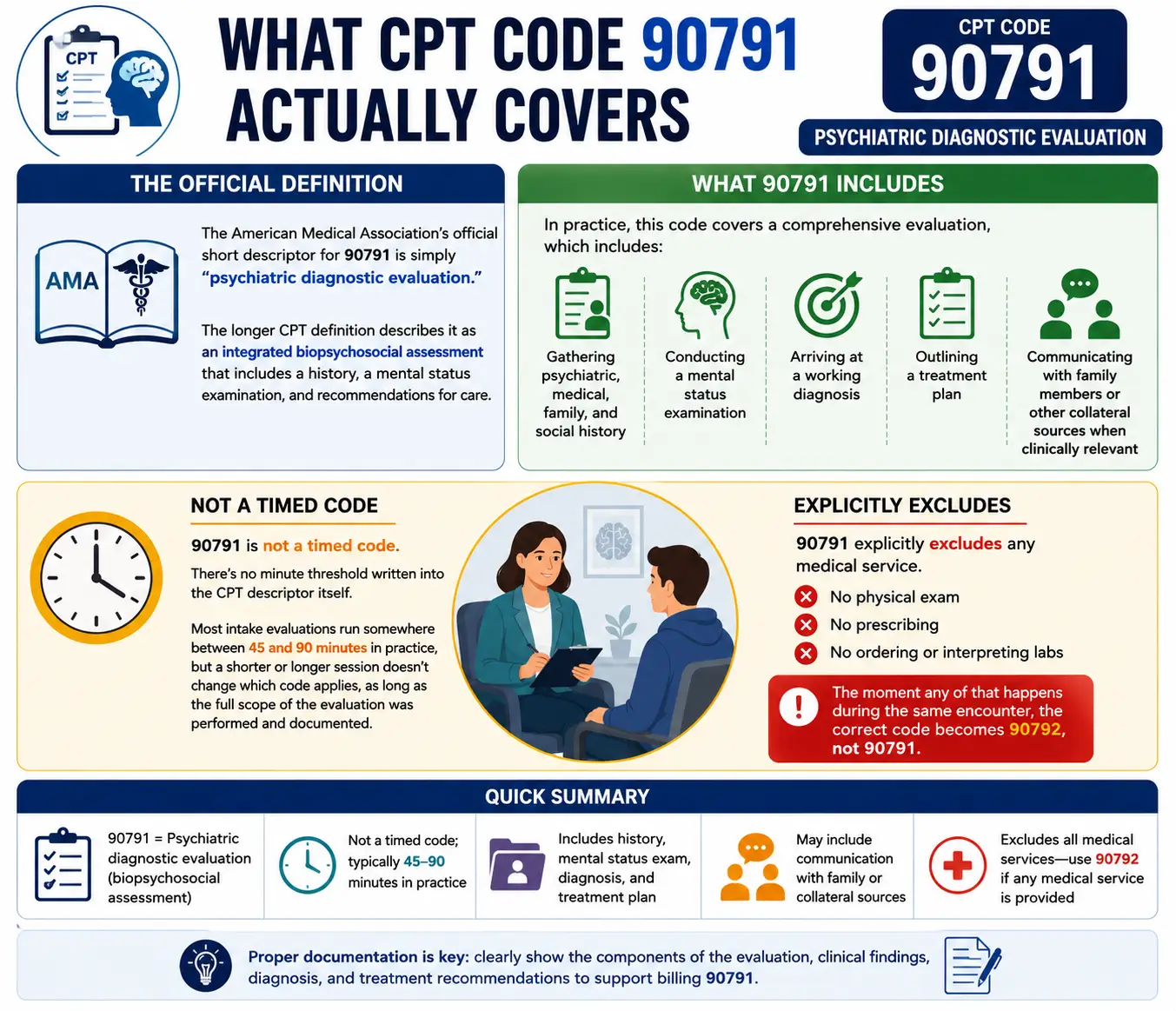
The American Medical Association’s official short descriptor for 90791 is simply “psychiatric diagnostic evaluation.” The longer CPT definition describes it as an integrated biopsychosocial assessment that includes a history, a mental status examination, and recommendations for care. In practice, that means the clinician is gathering the patient’s psychiatric, medical, family, and social history, conducting a mental status exam, arriving at a working diagnosis, and outlining a treatment plan. The evaluation can also include communication with family members or other collateral sources when that’s clinically relevant.
One detail trips up a lot of new billers: 90791 is not a timed code. There’s no minute threshold written into the CPT descriptor itself. Most intake evaluations run somewhere between 45 and 90 minutes in practice, but a shorter or longer session doesn’t change which code applies, as long as the full scope of the evaluation was performed and documented.
What 90791 explicitly excludes is any medical service. No physical exam, no prescribing, no ordering or interpreting labs. The moment any of that happens during the same encounter, the correct code becomes 90792, not 90791.
90791 versus 90792: picking the right code
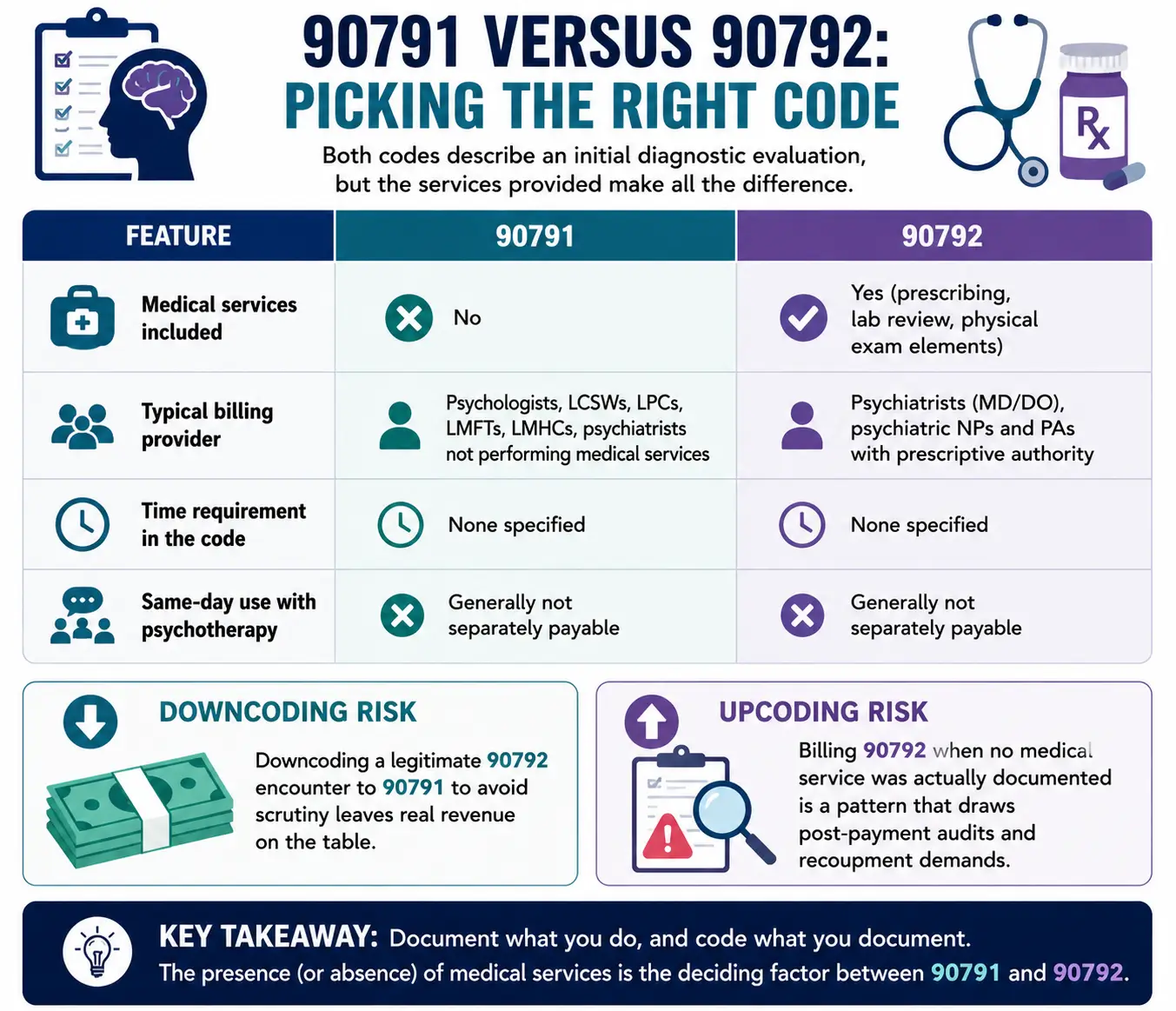
Because both codes describe an initial diagnostic evaluation, the distinction between them causes real confusion, and getting it wrong has revenue consequences in both directions.
Feature | 90791 | 90792 |
Medical services included | No | Yes (prescribing, lab review, physical exam elements) |
Typical billing provider | Psychologists, LCSWs, LPCs, LMFTs, LMHCs, psychiatrists not performing medical services | Psychiatrists (MD/DO), psychiatric NPs and PAs with prescriptive authority |
Time requirement in the code | None specified | None specified |
Same-day use with psychotherapy | Generally not separately payable | Generally not separately payable |
Downcoding a legitimate 90792 encounter to 90791 to avoid scrutiny leaves real revenue on the table. Going the other direction, billing 90792 when no medical service was actually documented, is the kind of pattern that draws post-payment audits and recoupment demands.
Who is allowed to bill 90791
Eligible providers include psychiatrists, clinical psychologists, licensed clinical social workers, licensed professional counselors, and licensed marriage and family therapists, subject to state scope-of-practice law and individual payer credentialing rules.
One change worth flagging for anyone still working from an older provider list: marriage and family therapists (MFTs) and mental health counselors (MHCs) became Medicare Part B providers for the first time on January 1, 2024. The Consolidated Appropriations Act of 2023 created this new Medicare benefit category, and CMS has since confirmed the enrollment requirements, which include a qualifying master’s or doctoral degree, state licensure, and at least two years or 3,000 hours of post-degree supervised clinical experience. Before that date, MFTs and MHCs simply could not bill Medicare directly for 90791 or anything else. Any billing team that hasn’t updated its provider-eligibility checklist since 2023 is working from outdated information.
Coverage rules and billing limits
Most payers, including Medicare, expect 90791 to be billed once per patient per provider within a defined episode of care rather than repeated at every visit. A second evaluation is sometimes payable if there’s documented clinical justification, such as a significant change in the patient’s condition, a gap in treatment followed by readmission, or a transfer to a new level of care. Billing it routinely as a stand-in for a regular session is a fast way to trigger a payer audit.
National Correct Coding Initiative edits generally block the same provider from billing 90791 and a psychotherapy code (90832, 90834, 90837) for the same patient on the same date. If interactive complexity factors are present, such as the need for an interpreter, involvement of a third party like a guardian or school official, or a session made significantly more difficult by a patient’s behavior, add-on code 90785 can be reported alongside 90791 to reflect that added work. It’s an add-on code, so it’s never billed alone.
Reimbursement rates for CPT 90791 in 2026
According to CMS fee schedule data compiled by the American Psychological Association’s Services practice group, the 2026 Medicare national non-facility payment rate for 90791 is $173.35, up from $166.91 in 2025, a 3.86 percent increase. That figure applies before geographic adjustment; actual payment depends on the Medicare Administrative Contractor’s locality-specific GPCI values, and rates in the facility setting run lower because a hospital or clinic, rather than the individual practice, absorbs part of the overhead.
Medicaid reimbursement for 90791 is set independently by each state program, so the rate a clinician sees in one state can look nothing like the rate in a neighboring one. Commercial payer rates are contract-specific and generally negotiated above the Medicare baseline, though the exact premium depends entirely on the individual agreement. For any payer other than Medicare, checking the actual contracted or state fee schedule is the only reliable way to know what a claim will pay, since published averages online vary too widely to be useful for financial planning.
Telehealth billing for 90791
Telehealth rules for behavioral health have moved faster than for almost any other service line, and 90791 is fully telehealth-eligible. As of the Consolidated Appropriations Act, 2026 (H.R. 7148), signed into law on February 3, 2026, Medicare telehealth flexibilities were extended through December 31, 2027. For behavioral and mental health services specifically, geographic and originating-site restrictions have already been removed on a more durable basis: a patient’s home qualifies as the originating site, and audio-only delivery is permitted when video isn’t feasible for the patient. The requirement for an in-person visit within six months before the first telehealth mental health encounter, and annually afterward, remains postponed, now pushed to January 1, 2028, under the same legislation.
Practically, that means claims for a telehealth 90791 evaluation should carry modifier 95 and the appropriate place-of-service code (02 for a non-home originating site, 10 when the patient is at home), and billing teams should keep the payer’s own telehealth policy on file, since Medicaid and commercial telehealth rules don’t always mirror Medicare’s.
Documentation that actually supports the code
Payers auditing a 90791 claim are looking for specific elements in the note, not just a session summary. At minimum, that means a documented chief complaint, history of present illness, relevant psychiatric, medical, family, and social history, a complete mental status exam, a DSM-5-TR or ICD-10-CM diagnosis, a risk assessment, and treatment recommendations or an initial treatment plan. A note that reads like a routine therapy session, without these elements clearly present, is one of the more common reasons an otherwise clean 90791 claim gets denied or, worse, gets flagged in a post-payment review months later.
Common billing mistakes worth checking for
A few patterns show up repeatedly in behavioral health billing audits:
- Billing 90791 and a psychotherapy code for the same patient, same provider, same day, which most payers bundle under NCCI edits.
- Reusing 90791 for a routine follow-up session instead of switching to the appropriate psychotherapy code once treatment is underway.
- Submitting a second or third 90791 for the same episode of care without documentation explaining why a new evaluation was clinically necessary.
- Missing modifier 95 or using the wrong place-of-service code on telehealth claims.
- Notes that skip the mental status exam or treatment plan, leaving the claim unsupported even when the service was genuinely provided.
Most of these are avoidable with a documentation checklist built into the intake workflow rather than caught after a denial arrives. For a code billed this often, that upfront discipline is usually what separates a clean claims rate from a recurring string of appeals.