



90836 CPT Code: Coverage, Reimbursement, and Documentation Tips
A psychiatrist spends fifteen minutes reviewing a patient’s response to sertraline, then another forty minutes working through cognitive restructuring for the same patient’s panic symptoms. Two distinct services happened in one visit, and Medicare wants them reported as two distinct line items. That second line item is where the 90836 CPT code comes in.
90836 is an add-on code for 38 to 52 minutes of individual psychotherapy delivered in the same encounter as an evaluation and management (E/M) service. It cannot stand alone on a claim. It only exists to describe the therapy portion of a visit where a prescriber also managed medication, ordered labs, or otherwise performed medical decision-making. Getting the details right matters for two reasons: it determines whether the practice gets paid for real clinical work, and it determines whether that claim survives an audit.
What the 90836 CPT code covers
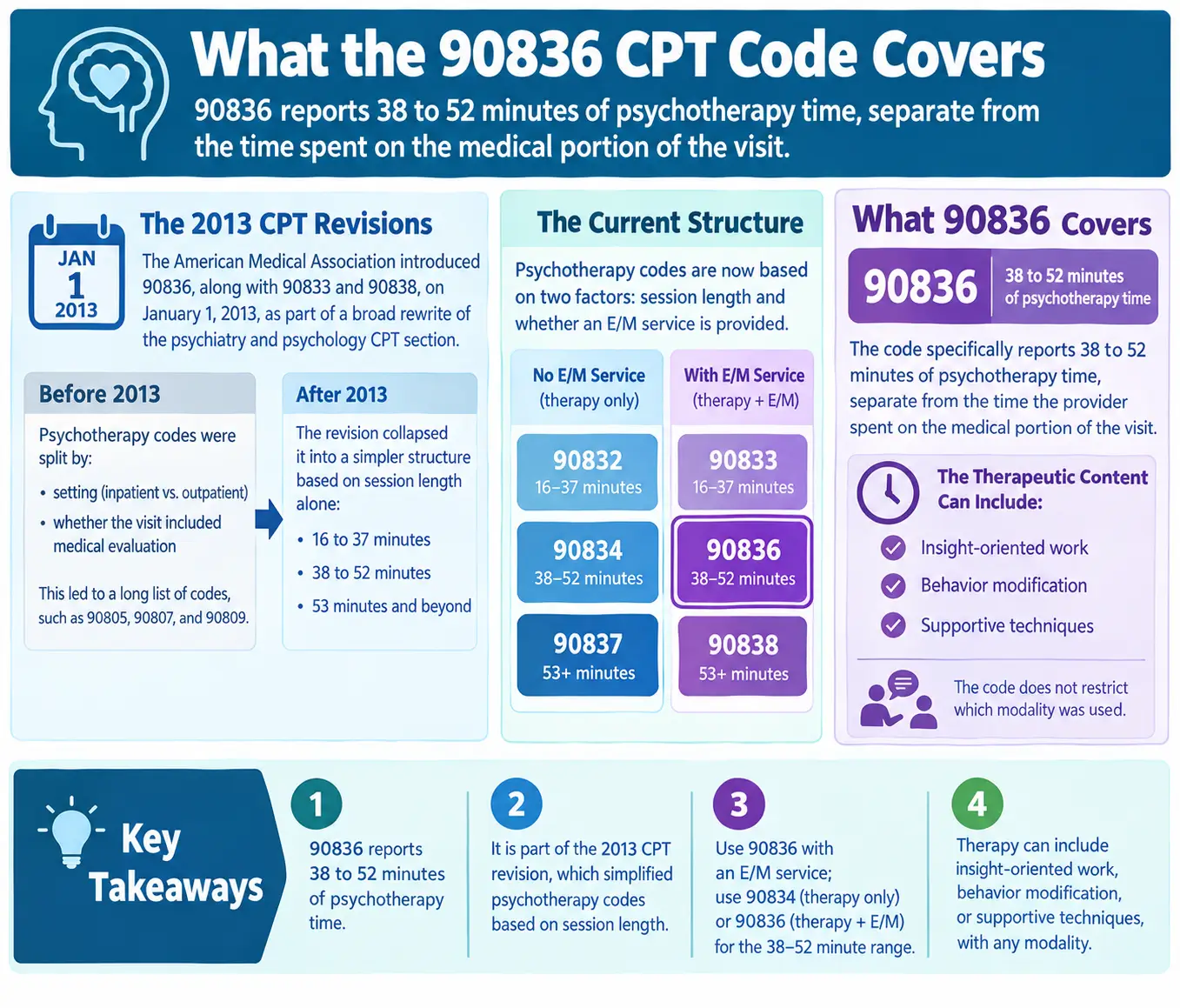
The American Medical Association introduced 90836, along with its siblings 90833 and 90838, on January 1, 2013, as part of a broad rewrite of the psychiatry and psychology CPT section. Before that date, psychotherapy codes were split by setting (inpatient versus outpatient) and by whether the visit included medical evaluation, which produced a long list of codes such as 90805, 90807, and 90809. The 2013 revision collapsed all of that into a simpler structure built around session length alone: 16 to 37 minutes, 38 to 52 minutes, or 53 minutes and beyond. When psychotherapy happens without an E/M service, providers report 90832, 90834, or 90837. When it happens alongside an E/M service, the add-on codes 90833, 90836, and 90838 apply instead.
90836 specifically describes 38 to 52 minutes of psychotherapy time, separate from whatever time the provider spent on the medical portion of the visit. The therapeutic content can include insight-oriented work, behavior modification, or supportive techniques, and the code does not restrict which modality was used.
Who can bill 90836
Because 90836 has to be paired with an E/M code, only clinicians who are credentialed to bill E/M services can use it. In practice, that means psychiatrists, psychiatric nurse practitioners, physician assistants, and clinical nurse specialists. Psychologists, licensed clinical social workers, licensed professional counselors, and marriage and family therapists do not bill E/M codes under Medicare, so 90836 is not available to them even when a session runs 45 minutes. Those clinicians report the standalone equivalent, 90834, instead.
This restriction has become more consequential as the field has changed. A 2021 study by Daniel Tadmon and Mark Olfson, published in the American Journal of Psychiatry using two decades of National Ambulatory Medical Care Survey data, found that psychotherapy appeared in only 21.6% of psychiatrist visits by 2016, roughly half the share seen twenty years earlier, and that just over half of psychiatrists had stopped providing any psychotherapy at all. 90836 exists for the shrinking group of prescribers who still combine medication management with meaningful talk therapy in the same appointment, rather than referring the therapy portion out.
How 90836 compares with related codes
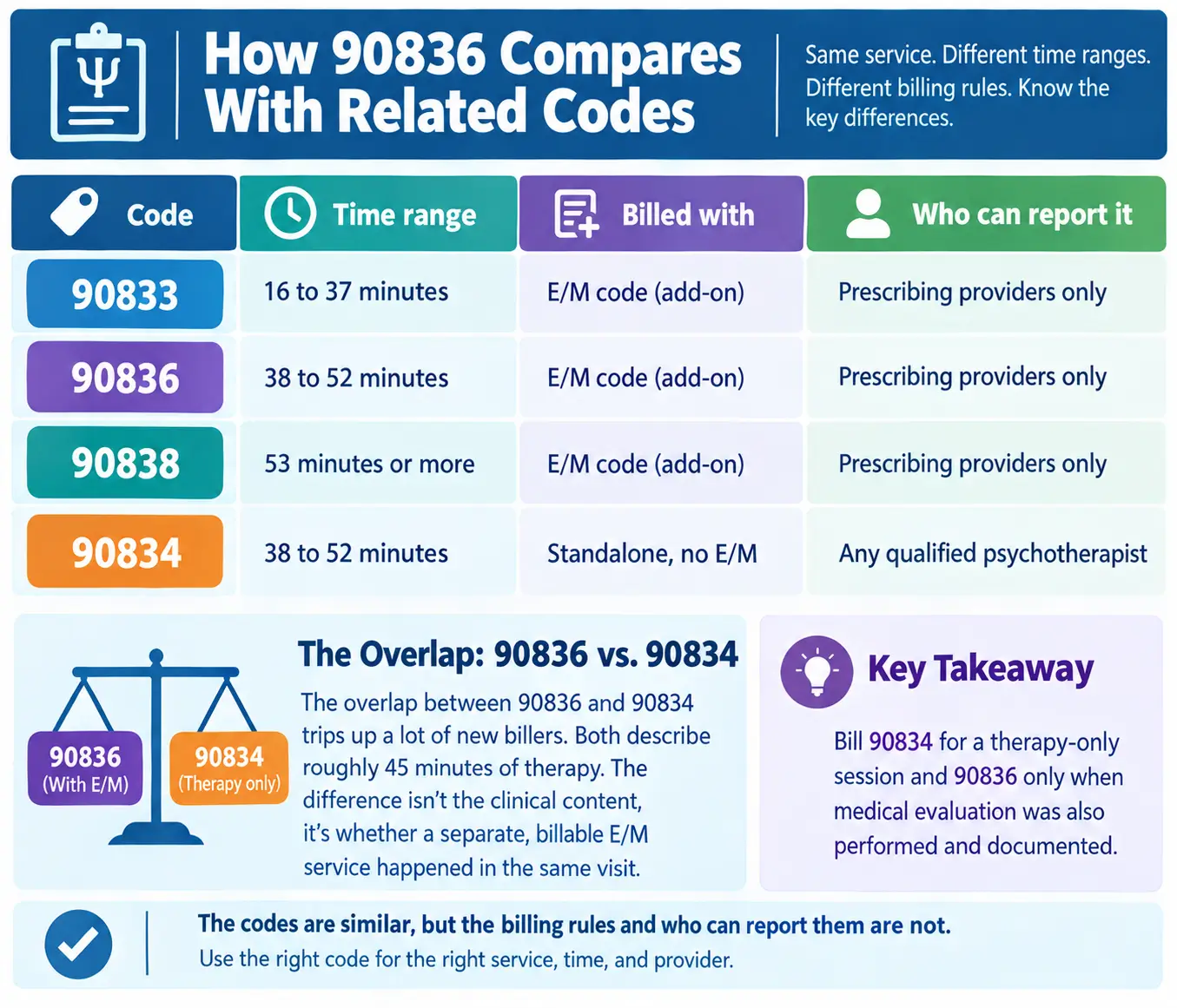
Code | Time range | Billed with | Who can report it |
90833 | 16 to 37 minutes | E/M code (add-on) | Prescribing providers only |
90836 | 38 to 52 minutes | E/M code (add-on) | Prescribing providers only |
90838 | 53 minutes or more | E/M code (add-on) | Prescribing providers only |
90834 | 38 to 52 minutes | Standalone, no E/M | Any qualified psychotherapist |
The overlap between 90836 and 90834 trips up a lot of new billers. Both describe roughly 45 minutes of therapy. The difference isn’t the clinical content, it’s whether a separate, billable E/M service happened in the same visit. Bill 90834 for a therapy-only session and 90836 only when medical evaluation was also performed and documented.
Coverage rules that determine whether 90836 gets paid
A Local Coverage Article maintained by Wisconsin Physicians Service (WPS), the Medicare Administrative Contractor for CMS jurisdictions J5 and J8, revised effective January 1, 2026, lays out the billing rules most Medicare contractors apply to this code family. A few points from that guidance matter more than the rest.
First, the E/M and the psychotherapy service must be significant and separately identifiable from each other. Most payers expect this to be signaled with modifier 25 appended to the E/M code, not to 90836 itself. Without it, a payer may bundle the two services and pay only the higher of the two rates.
Second, a separate diagnosis is not required to bill both services on the same date. This surprises a lot of billers who assume every combined claim needs two distinct ICD-10 codes. WPS’s guidance states plainly that one diagnosis can support both the E/M and the psychotherapy line, as long as the documentation shows two distinct services were rendered.
Third, time counted toward the E/M service and time counted toward 90836 cannot overlap. The E/M level itself is selected using medical decision-making, not time, and the minutes spent on medication review, chart documentation for the E/M portion, or ordering tests do not count toward the 38-to-52-minute therapy window. Prolonged services codes cannot be added on top of a 90833, 90836, or 90838 claim, which closes off a workaround some practices tried for very long combined visits.
Fourth, site of service does not restrict the code. Office, hospital outpatient, telehealth, and other settings are all payable locations for 90836, subject to the setting’s own billing rules.
On telehealth specifically, Medicare’s coverage of psychiatric add-on codes delivered remotely has continued into 2026, generally billed under the same E/M code appended with the appropriate telehealth place-of-service designation and modifier for audio-video or audio-only delivery. Payer rules on which modifier applies, and whether audio-only is accepted, vary enough that verifying with each payer before the first telehealth claim is worth the extra five minutes.
2026 Medicare reimbursement for 90836
Medicare pays physician services using the Physician Fee Schedule, which converts each code’s relative value units (RVUs) into a dollar amount using an annual conversion factor. For 2026, that conversion factor is $33.4009 for most providers, according to CMS’s published fee schedule data. Fee schedule tracking site MedFeeSchedule, reviewing CMS’s national RVU files, lists the 2026 national non-facility rate for 90836 at approximately $95.52, effective January 1, 2026. That figure is a national average before geographic adjustment; actual payment moves up or down a few percentage points depending on the locality’s Geographic Practice Cost Index, and facility settings pay a different, typically lower, rate than a private office.
To see what a combined visit is worth, pair 90836 with a common E/M code. Billing guidance site ClaimMaxRCM, citing CMS’s 2026 Physician Fee Schedule national payment files, puts the 2026 non-facility rate for CPT 99214 (an established-patient office visit of moderate complexity) at approximately $135.61. Add that to the $95.52 for 90836 and a combined medication management plus psychotherapy visit runs close to $231 nationally, before locality adjustment. Because these figures come from third-party compilations of CMS data rather than CMS itself, practices should confirm exact, locality-specific amounts through the CMS Physician Fee Schedule Look-Up Tool before relying on them for budgeting.
Commercial payers typically reimburse psychotherapy add-on codes above the Medicare rate, though the multiple varies by contract and region. Medicaid rates are set independently by each state agency and can run well below Medicare for the same code.
Documentation that keeps 90836 claims from being denied
Most 90836 denials trace back to a handful of preventable gaps:
- A blended note. Progress notes that mix medication review and therapy content into one undivided paragraph make it impossible for a reviewer to see two separate services. Structure the note so the E/M content (history, exam findings, medical decision-making) and the psychotherapy content (modality used, interventions, patient response, start and stop times) are clearly separated.
- Missing modifier 25. Leaving it off the E/M line is one of the most common reasons payers bundle the claim and underpay it.
- 90836 billed without a primary E/M code. As an add-on code, it will deny automatically if it appears on a claim with no qualifying E/M service.
- Time outside the 38-to-52-minute window. If the documented psychotherapy time falls to 30 minutes, the correct code is 90833, not 90836. Coders should treat the documented minutes, not the appointment length on the schedule, as the source of truth.
- No documented medical necessity for the psychotherapy portion. The clinical record should explain why talk therapy was needed in addition to medication management for that particular diagnosis and presentation.
Coders who build a habit of checking these five points before submission catch most of what an auditor would otherwise catch after the fact.
A practical scenario
A psychiatric nurse practitioner sees an established patient for bipolar disorder. She spends 12 minutes reviewing mood symptoms and adjusting a mood stabilizer dose, which supports a 99214 based on medical decision-making. She then spends 42 minutes on structured psychotherapy addressing the patient’s sleep disruption and relationship stress. The note documents both portions separately, with distinct start and stop times for the therapy segment. She bills 99214 with modifier 25, plus 90836 for the 42-minute therapy component. Total documented time across both services is 54 minutes, but only the 42 minutes tied to the therapeutic work counts toward the 90836 threshold.
Coverage for 90836 depends less on the clinical work itself, which is common in integrated psychiatric practice, and more on whether the note and the claim reflect two genuinely separate services rather than one long visit. Providers who keep that separation clear in both the chart and the billing line tend to see fewer denials and faster payment on exactly this kind of combined encounter.