



Best EHR for Billing and Insurance Claims in Mental Health (2026 Guide)
Mental health billing trips up clinicians who trained in general medicine. A single misread minute separates one psychotherapy code from another. A family session billed with the patient absent uses a different code than the same session with the patient in the room. Substance use records carry federal confidentiality rules that most software never accounted for. Pick the wrong system and denials pile up while sessions you already delivered go unpaid.
This guide compares the best EHR for billing and insurance claims in mental health in 2026, and it stays on what decides whether a clean claim goes out: clearinghouse access, claim scrubbing, real-time eligibility, remittance posting, and how each vendor prices the transactions you run daily. It is written for providers handling their own claims and for billing and coding students learning what behavioral health billing requires.
The stakes are measurable. The Kaiser Family Foundation’s review of 2024 claims on HealthCare.gov found insurers denied about 19% of in-network claims and roughly 37% of out-of-network claims. Behavioral health runs worse than the average specialty. Change Healthcare’s Revenue Cycle Denials Index put the industry-wide initial denial rate near 12% for 2024, and behavioral health claims draw heavier medical-necessity review. KFF reports that starting with plan year 2027, insurers on the federal exchange will have to tell the Centers for Medicare and Medicaid Services whether each denied claim was for a behavioral health service, data they have never had to separate before.
Why mental health billing breaks generic EHRs
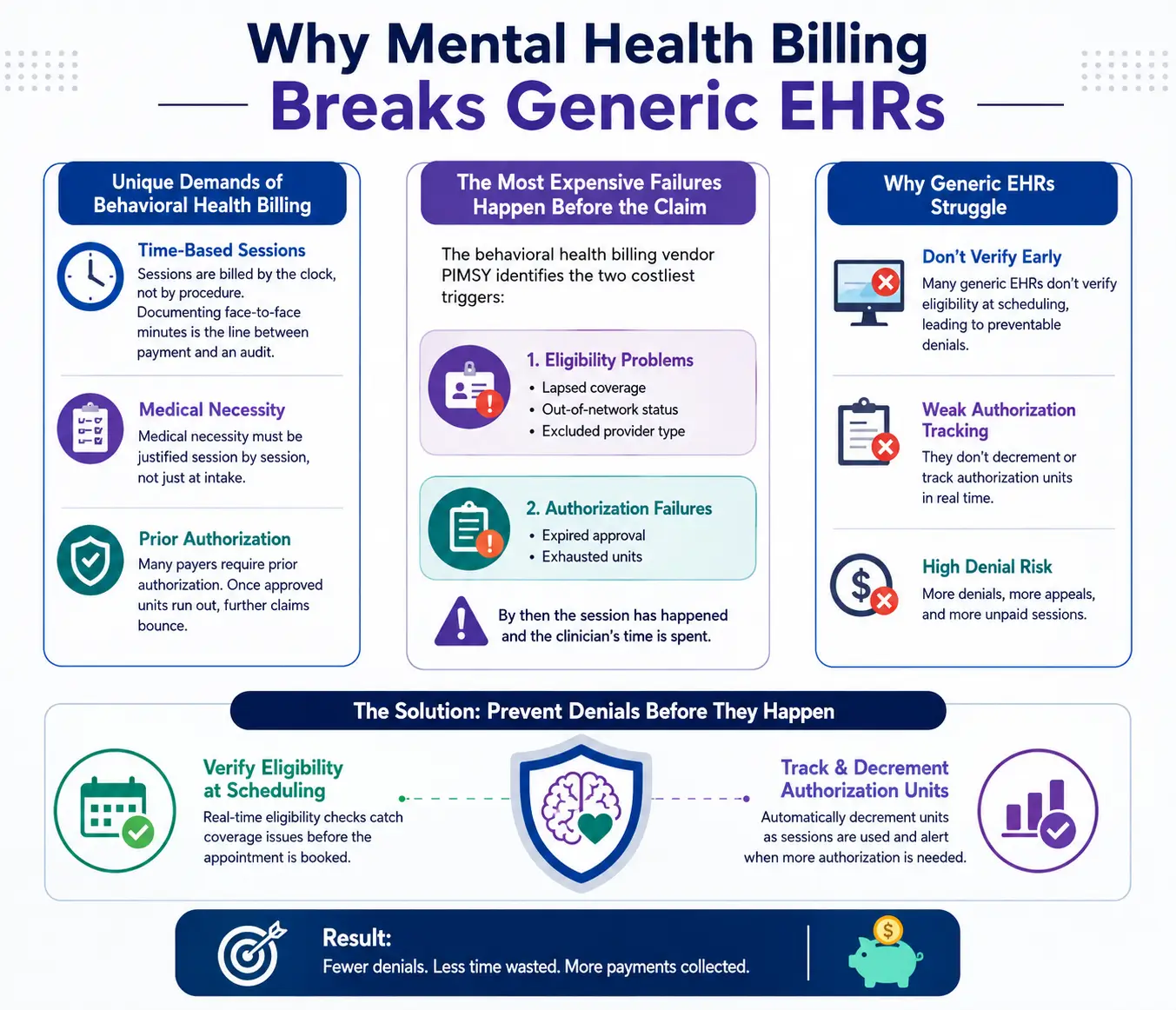
Behavioral health billing carries demands that general medical systems handle poorly. Sessions are billed by the clock rather than by procedure, so documenting face-to-face minutes becomes the line between payment and an audit. Medical necessity has to be justified session by session, not just at intake. Many payers require prior authorization, and once approved units run out, further claims bounce.
The expensive failures happen before a claim is ever built. The behavioral health billing vendor PIMSY identifies the two costliest triggers as eligibility problems (lapsed coverage, out-of-network status, an excluded provider type) and authorization failures (an expired approval or exhausted units). By then the session has happened and the clinician’s time is spent. Software that verifies eligibility at scheduling and decrements authorization units as they are used prevents denials that appeals rarely recover.
The billing features that decide whether you get paid
A short list matters more than any marketing page:
- Integrated clearinghouse to submit claims without a separate subscription, though vendors differ on payer reach and cost.
- Claim scrubbing that catches coding and formatting errors before submission.
- Real-time eligibility at scheduling, which catches the problems that become large-dollar denials weeks later.
- Electronic remittance advice (ERA) posting that applies payments automatically instead of by hand.
- Secondary claims filed cleanly for patients with two plans.
- Authorization tracking with auto-decrementing units.
- Transparent per-claim pricing, since some vendors bundle claims and others charge per claim and per ERA.
Best EHR for billing and insurance claims in mental health: five platforms compared
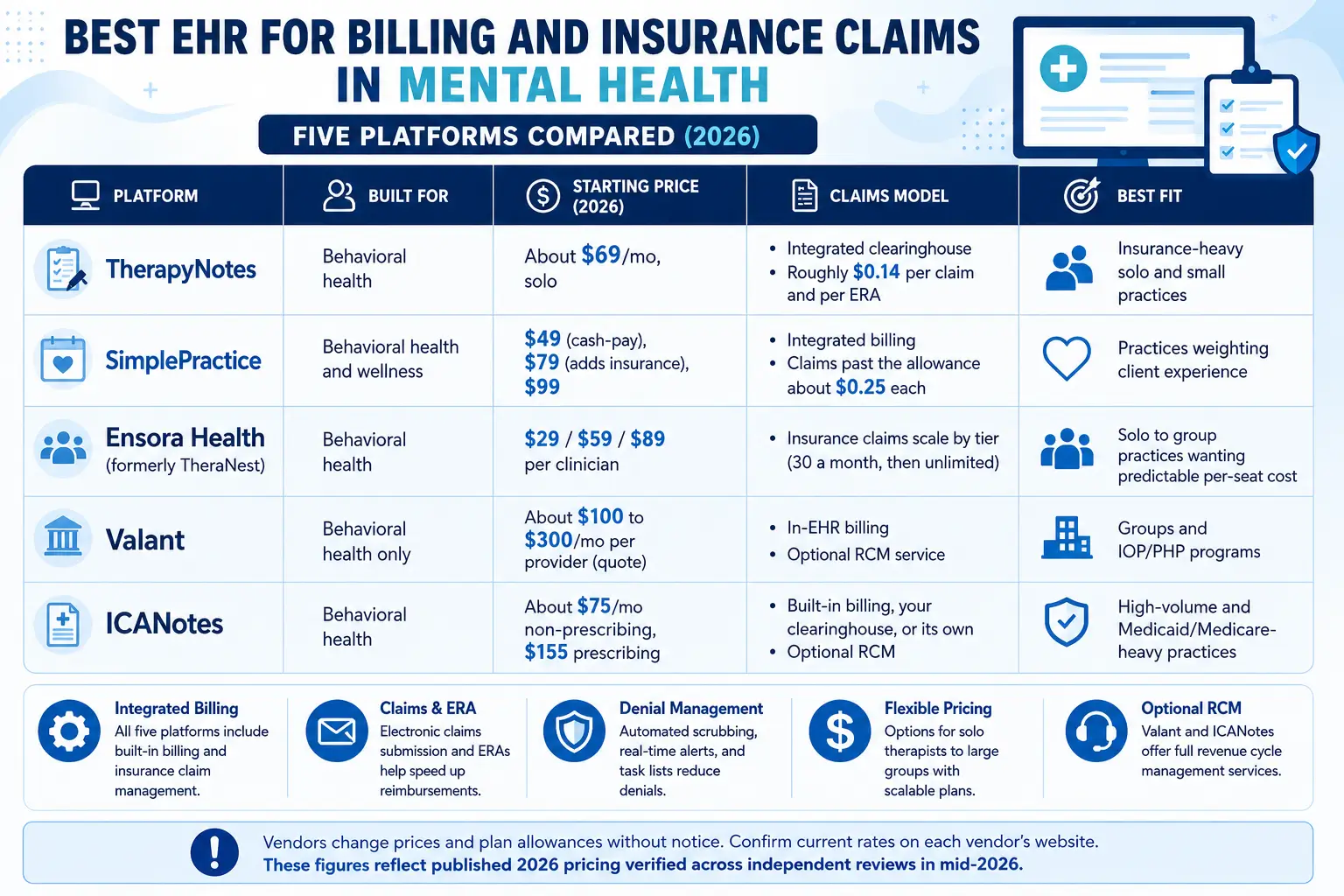
Platform | Built for | Starting price (2026) | Claims model | Best fit |
TherapyNotes | Behavioral health | About $69/mo, solo | Integrated clearinghouse; roughly $0.14 per claim and per ERA | Insurance-heavy solo and small practices |
SimplePractice | Behavioral health and wellness | $49 (cash-pay), $79 (adds insurance), $99 | Integrated billing; claims past the allowance about $0.25 each | Practices weighting client experience |
Ensora Health (formerly TheraNest) | Behavioral health | $29 / $59 / $89 per clinician | Insurance claims scale by tier (30 a month, then unlimited) | Solo to group practices wanting predictable per-seat cost |
Valant | Behavioral health only | About $100 to $300/mo per provider (quote) | In-EHR billing plus optional RCM service | Groups and IOP/PHP programs |
ICANotes | Behavioral health | About $75/mo non-prescribing, $155 prescribing | Built-in billing, your clearinghouse, or its own; optional RCM | High-volume and Medicaid/Medicare-heavy practices |
TherapyNotes was built for behavioral health, and its billing shows it. Claims run through an integrated clearinghouse reaching more than 2,000 payers, with automatic CMS-1500 generation, claim scrubbing, primary and secondary claims, and a task list that flags denials. Electronic claims and ERAs cost about $0.14 each, among the lowest rates in the category, and non-clinical billers get free accounts. Solo pricing starts near $69 a month, with HD telehealth priced separately.
SimplePractice reports more than 250,000 therapists and wellness professionals, the largest user base by most counts. Its scheduling, portal, and telehealth are the strongest features, and billing is capable rather than specialized. In 2026 the solo tiers run about $49 for cash-pay only, $79 to add insurance billing, and $99 a month, with claims past the allowance around $0.25 each.
Ensora Health, the rebranded TheraNest, offers three per-therapist tiers with unlimited clients, from about $29 to $89 a month. The entry plan covers scheduling, documentation, and card payments; the middle tier adds a set number of monthly insurance claims; the top tier removes claim limits and adds full telehealth. Supervisor co-signature workflows fit training settings and group practices.
Valant is built only for behavioral health, and it handles standard outpatient work alongside intensive outpatient (IOP) and partial hospitalization (PHP) programs. Eligibility checking and claims assistance live inside the EHR, and an optional revenue cycle management service staffs billers who work within your system. Published estimates put per-provider cost between $100 and $300 a month, quoted per practice, plus implementation fees.
ICANotes has served behavioral health for over two decades, and its billing is flexible: use the built-in module, connect your own clearinghouse, or use the vendor’s, with full revenue cycle management available. It supports the whole claims lifecycle and includes e-prescribing with controlled-substance support for prescribers. Pricing runs roughly $75 a month for a non-prescribing clinician and about $155 for a prescriber. Practices with high Medicaid and Medicare volume choose it for the depth.
Vendors change prices and plan allowances without notice, so confirm current rates on each vendor’s own page. These figures reflect published 2026 pricing verified across independent reviews in mid-2026.
The CPT codes that drive (or sink) claims
Software cannot fix a coding decision. Billers and clinicians need the core codes cold, because the wrong one leaves money unclaimed or invites review. The current time-based psychotherapy codes date to the 2013 CPT overhaul of psychiatry coding.
Code | Service | Key detail |
90791 | Psychiatric diagnostic evaluation, no medical services | Intake for non-prescribers; not valid for an established patient |
90792 | Diagnostic evaluation with medical services | Prescribers who add medication review or exam |
90832 | Individual psychotherapy | 16–37 minutes |
90834 | Individual psychotherapy | 38–52 minutes; the most commonly billed code |
90837 | Individual psychotherapy | 53+ minutes; frequent use triggers audits |
90846 / 90847 | Family psychotherapy | 90846 patient absent, 90847 patient present |
90853 | Group psychotherapy | Per participant |
90839 / 90840 | Crisis psychotherapy | 90839 first 60 minutes, 90840 each additional 30 (APA Services) |
A few rules save the most claims. A claim may carry only one time-based psychotherapy code; more than one is an automatic denial, per billing guidance from Alma. The American Medical Association’s midpoint rule requires reaching the lower time threshold to bill a code, and Medicare requires documenting start and stop times, or total time, for 90832, 90834, and 90837. The gap between 90834 and 90837 is a single documented minute, which is why payers audit frequent 90837 use and expect notes showing medical necessity. For telehealth, modifier 95 marks real-time video and modifier 93 marks audio only, paired with place of service 10 when the patient is at home. When a prescriber delivers medication management and psychotherapy in one visit, the encounter uses an evaluation and management code plus a psychotherapy add-on (90833, 90836, or 90838), often with modifier 25 on the E/M line.
Regulations reshaping behavioral health billing in 2026
Two federal changes touch billing directly. The updated 42 CFR Part 2 rule, issued by the Substance Abuse and Mental Health Services Administration within the Department of Health and Human Services, took effect on April 16, 2024, with mandatory compliance on February 16, 2026, when the HHS Office for Civil Rights began enforcement. It aligns substance use disorder confidentiality more closely with HIPAA and now allows a single patient consent to cover treatment, payment, and health care operations rather than a separate consent for each disclosure. Because those records feed claims, addiction programs have to handle consent inside billing, not around it.
Parity is the second. The Mental Health Parity and Addiction Equity Act of 2008, and the 2013 regulations as amended by the Consolidated Appropriations Act of 2021, remain in force and enforced; the Department of Labor and HHS each conduct at least 20 parity investigations a year. The newer 2024 final rule is a different situation. On May 15, 2025, the Departments of Labor, Health and Human Services, and Treasury announced they will not enforce its provisions that are new relative to 2013 for the 2025 and 2026 plan years, pending litigation brought by the ERISA Industry Committee plus an additional 18 months. In practice, parity still supports appealing behavioral health denials, even with the newest requirements on hold.
Matching the software to how you get paid
The best EHR for billing and insurance claims in mental health depends on your revenue mix. Insurance-dependent solo and small practices get the deepest claims workflow and the lowest per-claim fees from TherapyNotes. Practices that value client experience fit SimplePractice. Ensora Health suits those wanting predictable per-seat pricing that scales by tier. Groups running IOP or PHP programs, or wanting outsourced revenue cycle management, look to Valant or ICANotes, with ICANotes favored where Medicaid and Medicare volume runs high. Whatever you choose, the claim is only as clean as the code and the authorization behind it, so verify eligibility before the session, document the minutes, and match the code to the service you actually delivered.