



90791 CPT Code Description: Usage, Billing Rules, and Common Mistakes
Most outpatient mental health relationships begin with one claim line: 90791. The code stands for a psychiatric diagnostic evaluation delivered without any medical service. It carries no time requirement, allows one unit per date, and attracts more payer edits than its short descriptor suggests. This article explains the 90791 CPT code description, identifies who may report it, walks through the rules that control payment, and lists the errors that cause the most rejections. Payer contracts vary, so treat what follows as a starting point and confirm it against your own agreements.
What CPT 90791 reports
Think of 90791 as the formal intake. The clinician gathers the patient’s background, assesses current mental status, forms a diagnostic impression, and records next-step recommendations. CPT’s own guidance adds that the evaluation may draw on conversations with family members or other sources, and may involve reviewing or ordering diagnostic studies.
The code is not timed. A 40-minute intake and a 90-minute intake produce the same billing line. Because duration cannot justify the claim, the chart has to show the depth of the work.
From 90801 to 90791
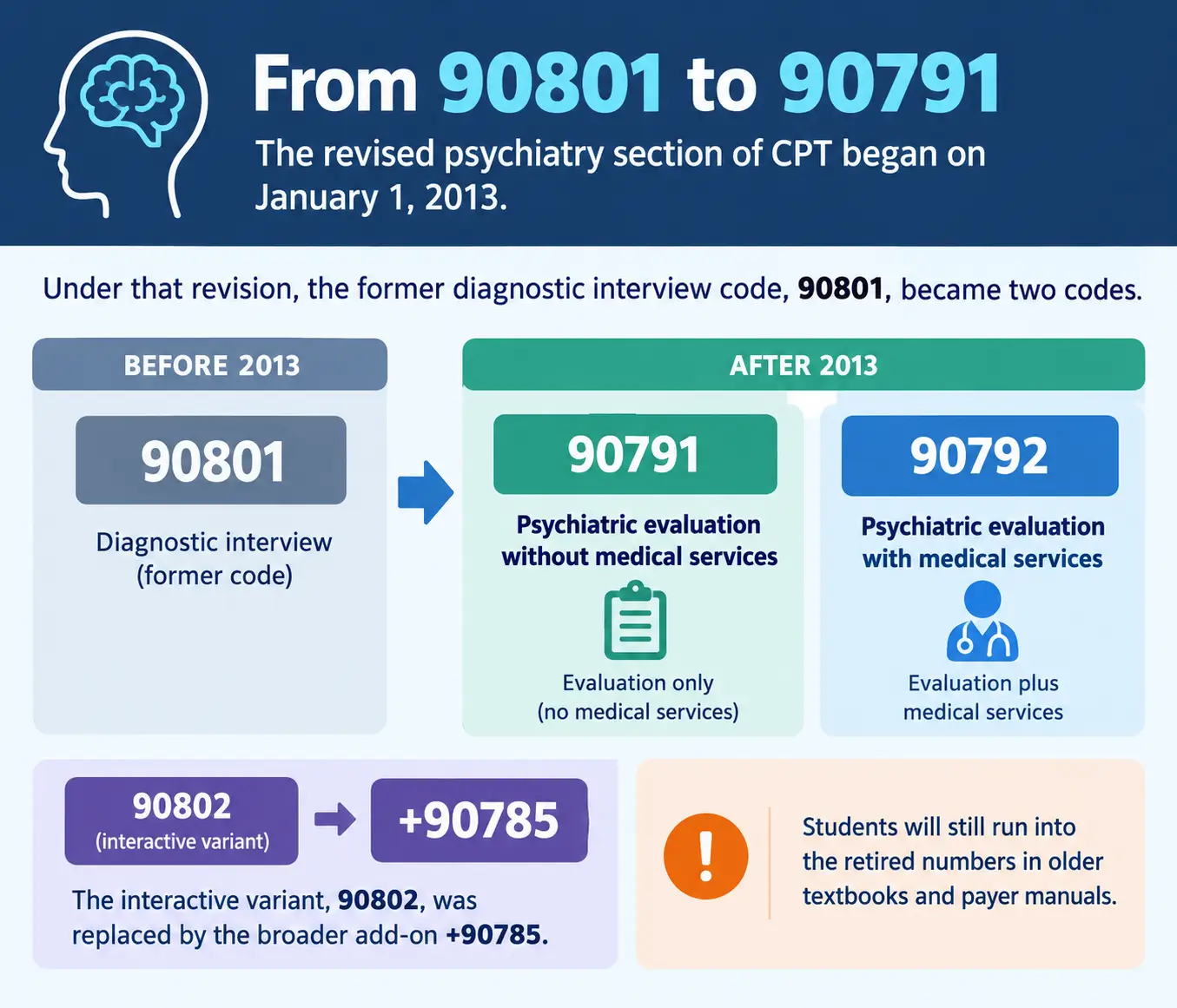
The revised psychiatry section of CPT began on January 1, 2013. Under that revision, the former diagnostic interview code, 90801, became two codes. One covers evaluations without medical services (90791) and the other covers evaluations with them (90792). The interactive variant, 90802, was replaced by the broader add-on +90785. Students will still run into the retired numbers in older textbooks and payer manuals.
Which clinicians bill it
Licensure and payer enrollment set the limits. A policy that Blue Cross and Blue Shield of Oklahoma put into effect on December 22, 2025, lists psychiatrists, doctoral-level psychologists, independently licensed master’s clinicians (social workers, counselors, family therapists), and medical practitioners such as nurse practitioners and physician assistants.
Medicare’s roster grew in 2024. Family therapists and mental health counselors gained enrollment rights on January 1, 2024, and no Medicare payment is available for dates of service before that. Highmark’s guidance explains that these clinicians receive the lesser of 80% of the billed charge or 75% of the psychologist amount.
States can narrow the field further. Michigan’s rule R 418.10207 points psychologists to 90791 and sends psychiatrists to either 90792 or a new-patient E/M code. A psychiatrist practicing there cannot assume 90791 is available.
Choosing between 90791 and 90792
Feature | 90791 | 90792 |
Medical services | None | Yes (exam elements, prescribing) |
Common billers | Qualified diagnostic clinicians | Physicians, NPs, PAs |
E/M substitute | Not applicable | New-patient E/M allowed |
+90785 add-on | Allowed | Allowed |
Blue Cross Oklahoma describes 90792 as the same diagnostic work plus further medical services, such as a physical exam or a prescription. The American Psychiatric Association’s 2013 coding table also states that a new-patient E/M code can be used in place of 90792. A prescriber’s license alone does not support 90792. The medical component has to be performed and documented.
Rules that determine payment
Daily limit and same-day exclusions
CPT permits one 90791 per date. The same person cannot also report an E/M visit for that patient that day, and psychotherapy of any kind, including crisis work, is off the table for the same date. A checklist built around Medicare LCD L33252 repeats the ban on same-day psychotherapy. If a clinician completes the evaluation and still has time, only 90791 is billed.
Two separate clinicians are treated differently. National Correct Coding Initiative edits attach to the same provider or same-specialty providers inside one group, so unrelated practitioners may be able to bill an evaluation and an E/M visit on a single date when payer criteria are met.
Repeat evaluations
Frequency is where payers diverge most. CPT allows the code to appear more than once when the patient and other informants are evaluated in separate encounters. A child’s intake followed by a stand-alone parent interview on a different day illustrates this.
Payer limits are stricter:
- The Medicare checklist supports a fresh evaluation after six months without psychiatric treatment, at inpatient admission, following a marked change in mental status, or when a second opinion or diagnostic clarification is required. It views routine repeat evaluations of chronic conditions as unnecessary.
- Blue Cross Oklahoma accepts the code once at the start of treatment and again only after a break of six months or longer.
Interactive complexity (+90785)
The APA’s 2013 overview confirmed that the add-on pairs with both evaluation codes. Blue Cross Oklahoma reserves it for situations where communication itself obstructs care: conflict or heightened agitation among participants, caregiver behavior that interferes with treatment, a disclosure that requires a mandated report, or play materials and assistive devices needed to reach a patient who cannot communicate in the usual way. The policy bars its use for interpreter services or added time, and a difficult session alone does not qualify.
Telehealth and reimbursement
According to Telehealth.HHS.gov, Medicare permanently covers mental health telehealth delivered at home, including audio-only visits, and the in-person visit requirement stays suspended through December 31, 2027. Since January 1, 2024, Medicare has paid home-based telehealth at the non-facility rate. Commercial plans make their own decisions, and some require video for first visits.
Medicare derives a payment by multiplying a code’s relative value units by a conversion factor. CMS finalized two factors for 2026: $33.57 for advanced APM participants and $33.40 for other clinicians.
What the chart should show
A 2018 compliance checklist from the University of Florida Jacksonville, built on LCD L33252, expects the presenting concern, symptom history with duration, past psychiatric care, medical background and medications, family and social history, a mental status exam, a working diagnosis, and a treatment plan with measurable goals. It also asks for session length with start and stop times, and a stated reason whenever relatives were interviewed in place of the patient. That checklist reflects one Medicare contractor, so compare it with your own.
The diagnosis on the claim matters as well. The same checklist requires an ICD-10 code showing a psychiatric illness or emotional or behavioral symptoms.
Frequent 90791 claim errors
- Billing psychotherapy on the same date. CPT, Medicare checklists, and state rules all exclude it.
- Combining 90791 with a same-provider E/M visit. The edit follows the individual or the specialty within a group.
- Selecting 90792 when no medical work occurred. The note must show exam elements or prescribing.
- Adding +90785 for an interpreter or extra minutes. The Blue Cross Oklahoma policy rules out both.
- Starting a new evaluation too early. A returning patient may still fall inside a six-month window.
- Leaving out duration and informant details. Missing start and stop times, or the reason a relative was interviewed, weaken the record.
90791 billing in brief
Since January 1, 2013, 90791 has covered the untimed opening diagnostic workup when no medical service is involved. It allows one unit per date, excludes same-day psychotherapy and same-provider E/M, and follows payer-specific repeat windows, often six months. Medicare’s in-person requirement for mental health telehealth is suspended through December 31, 2027. Check each payer’s current policy before you submit a claim.