


The 90849 CPT code describes multiple-family group psychotherapy. It applies to psychotherapy involving more than one family in a shared treatment session. However, identifying the correct service does not establish insurance coverage.
This distinction deserves attention before scheduling. A practice can select the right code and still receive a denial because the benefit excludes the service or the payer requires additional authorization.
For providers and billing students, accurate reporting starts with three questions: What treatment occurred? Whose condition was treated? What does that patient’s insurance allow?
What does the 90849 CPT code mean?
CPT 90849 identifies a multiple-family psychotherapy format, with different families participating together around treatment-related concerns. The presence of several relatives from one family does not, by itself, establish a multiple-family group.
For example, a clinician might treat adolescents and their caregivers together, addressing family interactions associated with the adolescents’ documented mental health conditions. This is an illustrative scenario, not a report of an actual patient encounter.
A discussion group or parenting lecture does not automatically qualify. The record should describe psychotherapeutic work, including the clinician’s interventions and their connection to treatment. Aetna’s Behavioral Health: Group Psychotherapy, Clinical Policy Bulletin 1100, reviewed August 20, 2026, distinguishes psychotherapy from educational classes and informal support activities.
How 90849 differs from related psychotherapy codes
Select the code according to the service delivered, including the family structure and patient attendance.
| Code | Service format | Main distinction |
|---|---|---|
| 90846 | Family psychotherapy without the patient | Treatment involves one family; the identified patient is absent. |
| 90847 | Family psychotherapy with the patient | The identified patient participates in the family session. |
| 90849 | Multiple-family group psychotherapy | More than one family participates in a shared psychotherapy session. |
| 90853 | Group psychotherapy other than a multiple-family group | Participants receive group psychotherapy outside the multiple-family format. |
These distinctions appear in Medicare contractor guidance and Wisconsin ForwardHealth’s procedure-code tables.
A cancellation can change code selection. If only one family attends a scheduled multiple-family group, reassess the service actually performed. Do not retain 90849 merely because it was entered when the appointment was booked.
Likewise, avoid substituting 90853 solely because a payer covers ordinary group therapy. The documented treatment must support the submitted code.
Time requirements and billing units
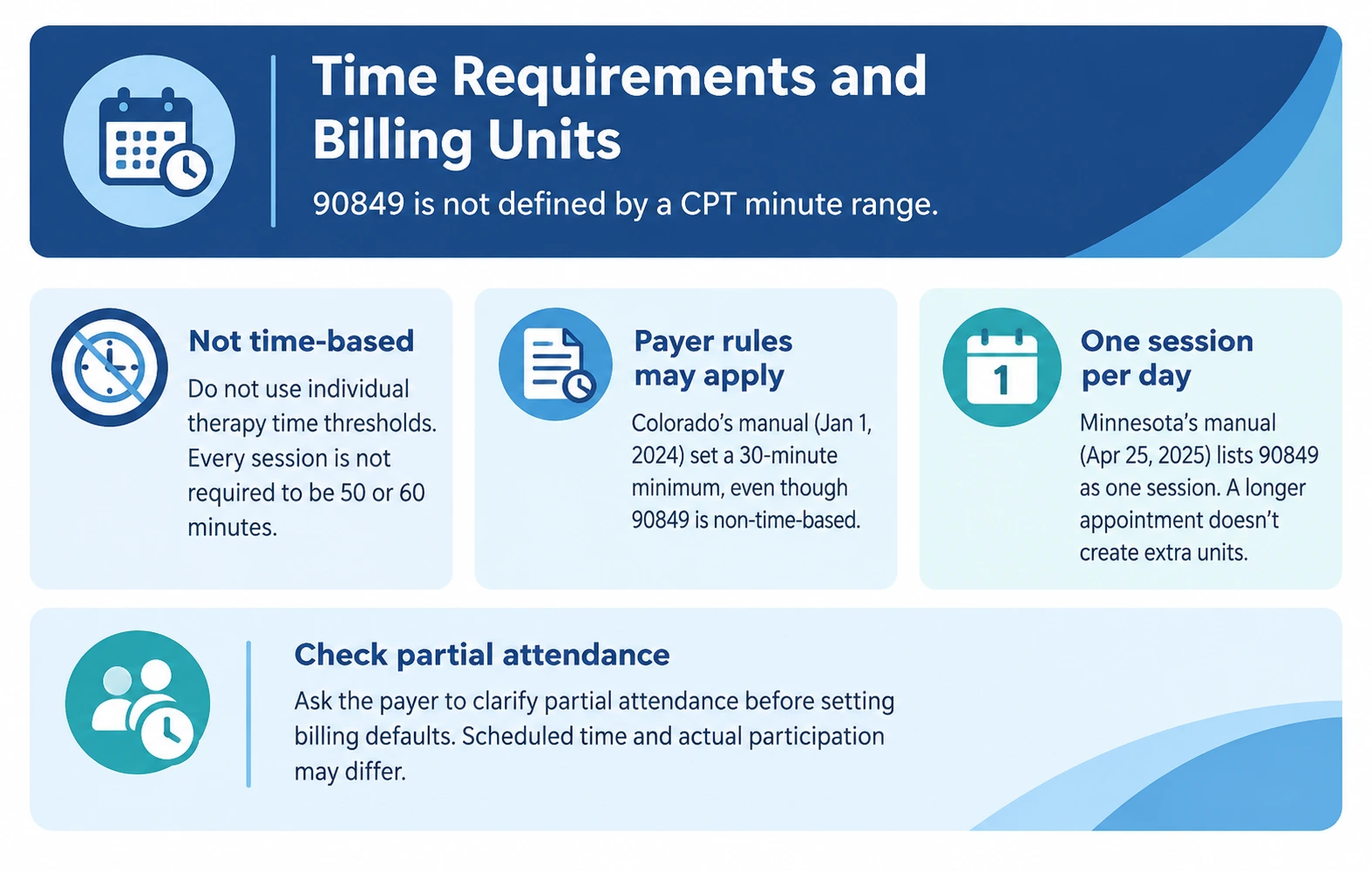
90849 is not defined by a CPT minute range. Do not import the time thresholds for individual psychotherapy or assume every multiple-family session must last exactly 50 or 60 minutes.
Payer requirements can still impose duration conditions. Colorado’s State Behavioral Health Services Billing Manual, effective January 1, 2024, described 90849 as non-time-based while specifying a 30-minute minimum for that program. This historical example demonstrates why an untimed code does not eliminate payer-specific timing rules; use the manual effective on the actual service date.
Document session duration even where reimbursement is session-based.
Minnesota’s Psychotherapy provider manual, revised April 25, 2025, lists 90849 as one session. Under that structure, a longer appointment does not automatically produce extra units.
Ask the payer to clarify partial attendance before establishing billing defaults. A scheduled duration and a patient’s actual participation may differ.
Does Medicare cover CPT 90849?
Medicare generally does not cover 90849. Noridian’s Mental Health guidance identifies it as generally noncovered and describes an appeal route.
There is a qualification. Medicare coverage article A56937, Billing and Coding: Psychiatry and Psychology Services, revised effective April 1, 2026, states that claims may receive individual consideration. The article explains that the service ordinarily fails Medicare’s standard for therapy primarily directed at the beneficiary’s condition.
Individual consideration is not routine approval.
Before providing the service, check the applicable Medicare Administrative Contractor’s policy and any required beneficiary notice procedures. Do not promise payment based on another jurisdiction’s guidance or assume that coverage of 90847 extends to 90849.
Medicaid and commercial insurance coverage
Medicaid rules vary by program
Minnesota’s manual allows separate billing for each patient in the family group, but explicitly distinguishes patients from accompanying family members. It also identifies a calendar-year authorization threshold of 10 multiple-family group psychotherapy sessions. That threshold is specific to Minnesota’s program, not a national Medicaid limit.
Wisconsin ForwardHealth lists 90849 with provider-level modifiers, including HO for master’s-level services and HP for doctoral-level services. These are examples of state-specific claim requirements, not modifiers every practice should attach.
For a Medicaid managed care member, verify the member’s plan instructions as well as relevant state requirements.
Commercial coverage requires plan verification
Aetna’s August 2026 policy lists 90849 among services potentially covered when selection criteria are met. Its criteria include a documented behavioral health disorder, functional impairment, and a treatment plan established within the preceding 90 days. Coverage remains subject to benefit terms.
A useful verification request names the exact code:
Record the response, reference number, and policy version. A general confirmation that “family therapy is covered” leaves the multiple-family service unresolved.
Reimbursement: How to establish the expected payment
There is no single payment amount that this guide can responsibly quote for every practice. Establish the applicable allowance through the payer’s current fee schedule or the practice’s contract.
Build the estimate around these questions:
- Is 90849 a covered benefit for this member?
- Is the rendering clinician eligible and enrolled for the service?
- Does the contract pay separately for the session?
- Which unit definition and modifiers apply?
- What deductible, copayment, or coinsurance remains?
Keep the billed charge separate from the allowed amount when discussing costs.
After adjudication, compare the remittance with the verified contract terms. Classify a benefit exclusion separately from an authorization denial or payment discrepancy. That distinction determines whether the next step is a corrected claim, supporting records, a contractual inquiry, or an appeal.
Do not estimate collectible revenue by multiplying the attendance count by a posted rate. Accompanying relatives are not automatically separately billable patients.
Documentation that supports the service
Use a session note that connects the group’s activities with the identified patient’s treatment. A reusable structure can prompt the clinician to record:
- Service date, actual duration, location, and delivery method.
- Number of participating families and the patient’s attendance.
- Participating relatives’ relationships to the patient.
- Documented diagnosis, relevant symptoms, and functional difficulties.
- Treatment objective addressed during the session.
- Specific psychotherapy interventions.
- Patient or family response and the next treatment step.
- Clinician signature and credentials.
Aetna’s policy expressly requests duration, treatment goals, interventions, participation, progress, and provider identification.
Do not depend solely on a shared group summary. As a practical documentation check, ask whether a reviewer could understand why this particular patient received the service without opening another family’s record.
An illustrative progress-note excerpt
Three families attended the 60-minute session. The identified adolescent participated with a parent. Treatment addressed avoidance and escalating parent-child exchanges associated with the patient’s documented anxiety disorder. The clinician facilitated role-play, identified reassurance patterns, and coached a planned response to avoidance. The patient completed one exercise with prompting. Parent and patient agreed to practice the response before the next session.
This example is invented for instruction and is not a complete clinical record. Actual documentation must reflect what occurred, including limited participation or lack of progress.
Protect psychotherapy notes appropriately
Routine billing-support documentation is distinct from separately maintained psychotherapy notes. HHS explains that the HIPAA definition of psychotherapy notes excludes items such as session timing, diagnosis summaries, treatment plans, and progress summaries.
Maintain reviewable clinical documentation without automatically submitting separately protected process notes. HHS generally requires authorization for disclosures of those psychotherapy notes for payment, subject to applicable exceptions.
Modifiers, telehealth, and same-day services
Do not add 90785, the interactive complexity code, to 90849 because the session involved conflict or difficult communication. The American Academy of Child and Adolescent Psychiatry’s Interactive Complexity guide identifies family psychotherapy, including 90849, among services that cannot be reported with that add-on.
For telehealth, verify current coverage of 90849 itself, the permitted delivery method, and required place-of-service and modifier combinations. Wisconsin’s procedure table, for example, includes telehealth places of service for 90849; this does not establish coverage under another payer.
When additional services occur on the same date, review applicable code-pair edits and documentation requirements. Noridian specifically directs providers to check same-day codes against National Correct Coding Initiative edits. A separate appointment entry alone does not resolve a bundling restriction.
A final claim review before submission
Before releasing a 90849 claim, compare the attendance record, clinical note, authorization, and claim line. Confirm that the multiple-family format actually occurred and that the identified patient, clinician, units, and service date agree across those records.
Track authorization usage by the payer’s unit definition. When a limit is expressed in sessions, counting minutes will not answer how many authorized visits remain.
The 90849 CPT code supports accurate reporting of multiple-family group psychotherapy, but payment depends on the applicable benefit and billing rules. Confirm coverage before treatment, document the patient-specific work, and resolve claim discrepancies against the policy effective on the service date.