



96136 CPT Code Description: Complete Billing & Documentation Guide
Medical billing requires absolute precision to prevent claim denials and audit penalties. In 2019, the American Medical Association restructured the entire category of psychological and neuropsychological testing codes. This overhaul separated the physical administration of tests from the clinical evaluation of the results. The 96136 CPT code description applies specifically to the first 30 minutes of test administration and scoring performed directly by a physician or qualified healthcare professional.
Healthcare organizations must document exact times, specific test names, and provider credentials to secure reimbursement under these rules. The Centers for Medicare and Medicaid Services, along with commercial payers, strictly enforce the parameters of this code. Billing this code for a single test, or billing it when a technician performs the work, leads to automatic claim rejections.
Understanding the 96136 CPT code description
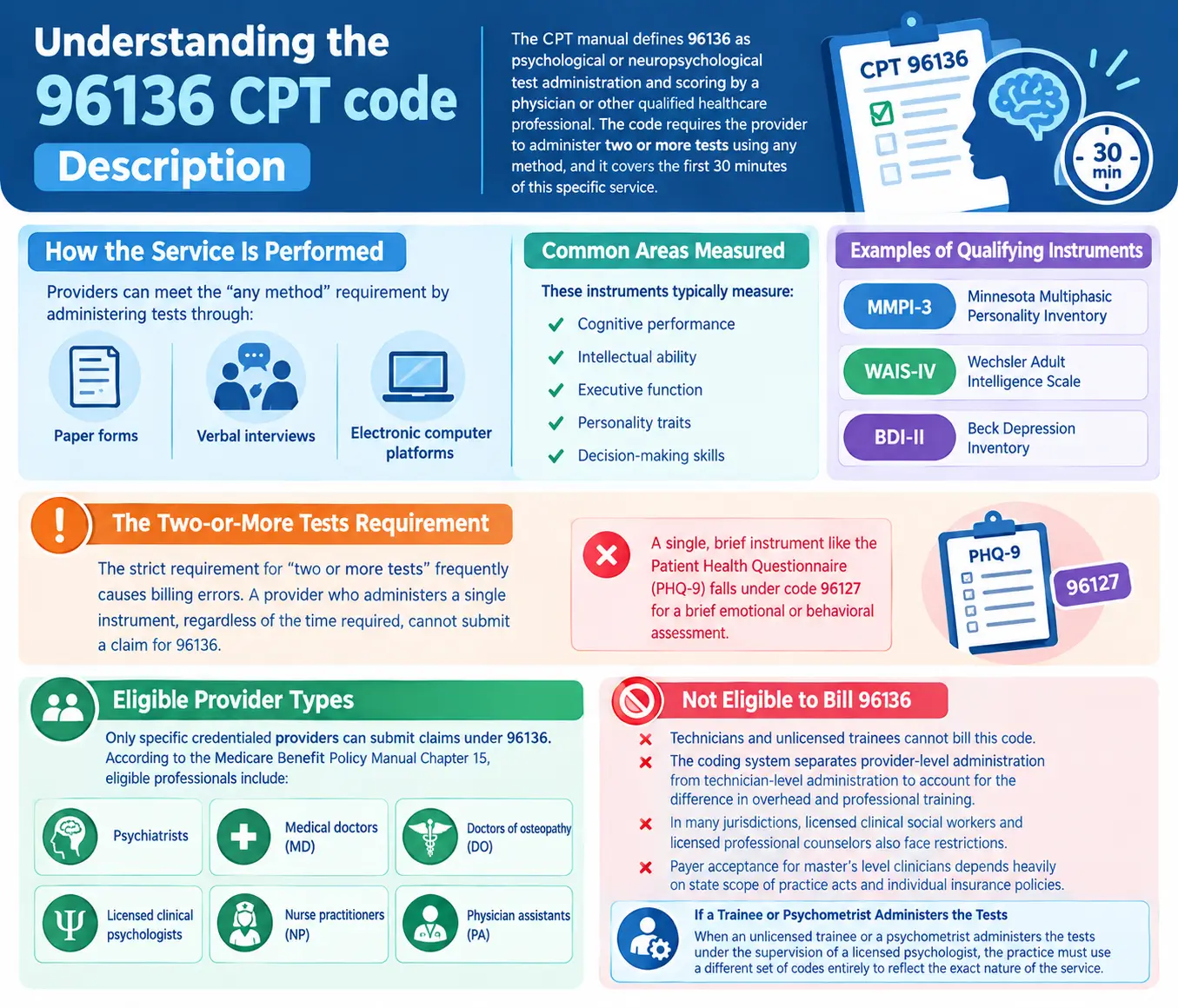
The Current Procedural Terminology manual defines 96136 as psychological or neuropsychological test administration and scoring by a physician or other qualified healthcare professional. The code specifies that the provider must administer two or more tests using any method, and the code covers the first 30 minutes of this specific service.
Providers meet the “any method” requirement by administering tests through paper forms, verbal interviews, or electronic computer platforms. These instruments typically measure cognitive performance, intellectual ability, executive function, personality traits, and decision-making skills. Examples of qualifying instruments include the Minnesota Multiphasic Personality Inventory (MMPI-3), the Wechsler Adult Intelligence Scale (WAIS-IV), and the Beck Depression Inventory (BDI-II).
The strict requirement for “two or more tests” frequently causes billing errors. A provider who administers a single instrument, regardless of the time required to complete it, cannot submit a claim for 96136. A single, brief instrument like the Patient Health Questionnaire (PHQ-9) falls under code 96127 for a brief emotional or behavioral assessment.
Eligible provider types and credentialing rules
Only specific credentialed providers can submit claims under 96136. According to the Medicare Benefit Policy Manual Chapter 15, eligible professionals include psychiatrists, medical doctors, doctors of osteopathy, licensed clinical psychologists, nurse practitioners, and physician assistants.
Technicians and unlicensed trainees cannot bill this code. The coding system separates provider-level administration from technician-level administration to account for the difference in overhead and professional training. In many jurisdictions, licensed clinical social workers and licensed professional counselors also face restrictions when billing 96136. Payer acceptance for master’s level clinicians depends heavily on specific state scope of practice acts and individual commercial insurance policies.
When an unlicensed trainee or a psychometrist administers the tests under the supervision of a licensed psychologist, the practice must use a different set of codes entirely to reflect the exact nature of the service.
Time calculation rules and exact thresholds
Billing time-based CPT codes requires exact tracking. Providers must spend a minimum of 16 minutes administering and scoring tests to submit a claim for the first 30-minute block of 96136. This calculation follows standard time-based billing rules, requiring the provider to cross the halfway point of the stated time plus one minute.
The time measured represents total time, not exclusively face-to-face patient contact. The clock starts when the provider begins giving the instructions for the first test. It continues running while the patient completes the test under the provider’s supervision. It also includes the time the provider spends calculating the raw scores immediately afterward.
The clock does not include administrative tasks. Medical billers cannot count time spent greeting the patient, scheduling future appointments, or discussing insurance benefits.
Utilizing add-on code 96137 for extended testing
When a testing session exceeds 30 minutes, billers use the add-on code 96137. This code covers each additional 30-minute block of time spent administering and scoring tests. Because 96137 is an add-on code, medical billers cannot submit it alone. It must always appear on a claim directly beneath the primary 96136 code.
Calculating multiple units requires crossing the 16-minute threshold of each subsequent block. The American Medical Association provides specific time parameters for billing these combinations.
|
Total Testing Time |
Primary Code Billed |
Add-on Code Billed |
|
1 to 15 minutes |
Not reportable |
None |
|
16 to 45 minutes |
96136 (1 unit) |
None |
|
46 to 75 minutes |
96136 (1 unit) |
96137 (1 unit) |
|
76 to 105 minutes |
96136 (1 unit) |
96137 (2 units) |
|
106 to 135 minutes |
96136 (1 unit) |
96137 (3 units) |
Consider a scenario where a licensed clinical psychologist spends 80 minutes administering a battery of three tests and calculating the raw scores. The medical biller generates one unit of 96136 to cover the first 30 minutes. The biller then generates two units of 96137 to cover the remaining 50 minutes. The total time justifies two units of the add-on code because the remaining 50 minutes covers one full 30-minute block plus 20 minutes, which successfully crosses the 16-minute threshold for the final block.
Distinguishing between 96136 and technician code 96138
Practices face immediate claim denials when they confuse provider-administered tests with technician-administered tests. If a trained technician or psychometrist administers the tests under the supervision of a physician, the practice must use code 96138 for the first 30 minutes and 96139 for each additional 30 minutes.
Medicare reimburses these codes at different rates based on the administrator’s credentials. According to the Medicare Physician Fee Schedule, the non-facility national payment amount for 96136 is consistently higher than the payment for 96138. The payment gap reflects the higher cost of a physician’s or psychologist’s time compared to a technician’s time.
Navigating National Correct Coding Initiative edits
The National Correct Coding Initiative blocks practices from billing 96136 and 96138 for the same patient on the same day without a specific modifier. If a clinical psychologist starts the testing session and a technician finishes the battery two hours later, the billing team must append a modifier to the secondary code to indicate separate and distinct services.
Without the modifier, the payer’s automated system will deny the secondary claim as mutually exclusive. The American Psychological Association recommends consulting specific payer policies before appending these modifiers, as commercial insurance companies may apply National Correct Coding Initiative edits differently than Medicare.
Mandatory elements for clinical documentation
Clean claims require highly specific medical records. The Office of Inspector General frequently targets behavioral health and psychological testing codes for insufficient documentation. To justify billing 96136, the patient’s chart must contain specific, verifiable data points that an auditor can easily identify.
First, the clinical record must name the exact tests administered. Vague statements such as “administered cognitive tests” or “completed psychological battery” will trigger payer denials upon review. The provider must list two or more distinct instruments by their formal names, such as the Woodcock-Johnson IV or the Conners 3.
Second, the chart must include precise start and stop times. Recording “45 minutes” is insufficient for an audit. The provider must write exact timestamps, documenting exactly when the testing began and ended (e.g., “Administration: 10:00 AM to 10:50 AM”).
Third, the documentation must explicitly identify who performed the service. If the medical record implies an unlicensed student gathered the data but the practice submits the claim under the supervising psychologist’s National Provider Identifier using 96136, insurers will reclaim the payment.
Finally, the chart must establish medical necessity. The administration of the tests must connect directly to the patient’s presenting problem, symptoms, or suspected diagnosis, supported by the appropriate ICD-10 codes. Routine screening without a specific medical indication does not meet the medical necessity threshold for these codes.
Proper modifier application for complex claims
Many providers complete an Evaluation and Management service, such as a diagnostic interview, during the same visit as the psychological testing. Billing both services on the same date requires proper sequencing and modifier application.
The medical biller lists the Evaluation and Management code first. They append modifier 25 to this code to show it was a significant, separately identifiable evaluation performed by the same physician on the same day as the procedure. Next, the biller lists 96136 with modifier 59 (or the appropriate X-modifier for Medicare claims) to indicate the testing was a distinct, independent procedural service. Failure to use these modifiers results in bundled payments, where the insurer only pays for the evaluation visit and discards the testing codes.
Providers must also avoid billing 96136 alongside 96127 on the same date of service unless the documentation clearly separates the two activities. Code 96127 functions as a brief, self-administered screening tool. Payer policies generally restrict billing a brief screening and a full test administration simultaneously. The comprehensive testing absorbs the need for the brief screening.
Differentiating administration from clinical evaluation
The 96136 code strictly compensates the physical act of giving the test and calculating the raw mathematical scores. It does not cover the intellectual work of interpreting what those scores mean, forming a diagnosis, or developing a treatment plan.
For integration, clinical decision-making, interactive feedback with the patient, and formal report writing, providers use a completely separate set of evaluation codes. Code 96130 covers the first hour of psychological testing evaluation services, and 96131 covers each additional hour.
Structuring a complete psychological testing claim
A complete psychological testing battery appears on a medical claim form as a combination of these distinctly categorized codes. A standard comprehensive claim includes separate lines for evaluation and administration.
- 96130 (1 unit): The first hour spent reviewing records, analyzing the raw data, and writing the clinical evaluation report.
- 96131 (2 units): Two additional hours spent integrating the data and forming the complex diagnosis.
- 96136 (1 unit): The first 30 minutes spent physically administering the tests to the patient.
- 96137 (3 units): An additional 90 minutes spent administering the remaining tests and calculating all raw scores.
This specific separation ensures providers receive accurate compensation for both the technical gathering of data (the 96136/96137 series) and the professional, specialized analysis of that data (the 96130/96131 series).
Core requirements for 96136 claim submission
Correctly applying the 96136 CPT code description requires strict adherence to payer guidelines, precise timekeeping, and detailed medical records. Medical billing departments must verify that the performing provider holds the appropriate credentialing level and that the session included at least two separate testing instruments. Documenting exact start and stop timestamps, recording the specific names of all administered tests, and separating the administration codes from the clinical interpretation codes protects medical practices from post-payment audits.